Since I live on a street dedicated to St.
Francis of Assisi, and since I can see a church dedicated to St. Francis of
Assisi right out my bedroom window, and since my darling Maritino and I were married by a Franciscan priest, and since our
current ever more lovable Pope chose his papal name (many believe) to honor St.
Francis of Assisi, I figured it would be a good idea to write a little post today on 4 October, on
occasion of the feast day of one of Italy’s all-time best-loved saints.
Instead going into St. Francis’s life andworks, which I’m guessing most people are already familiar with, I thought I’d
suggest five ways to celebrate his feast day, and five different Italian cities
in which to do it.
Assisi
Basilica of San Francesco d'Assisi, Assisi.[source]
As the saint’s hometown, this is the
obvious choice. In fact, this is where Pope Francis himself decided to
celebrate St. Francis’s Day, so expect a lot of crowds if you choose this
option. Besides the sheer majesty of the 13th-century basilica, one of the most
important fresco cycles of the great Giotto di Bondone, and in fact one of the
most celebrated works of art of that magical period when the buds of medieval
art began to blossom into the Renaissance.
The Woman's Confession, Giotto. Basilica of San Francesco d'Assisi, Assisi. [source]
The Dream of the Palace, Giotto. Basilica of San Francesco d'Assisi, Assisi. [source]
San Francis receives the Stigmata, Giotto. Basilica of San Francesco d'Assisi, Assisi. [source]
The 28 frescoes that line the lower
section of the nave of the Basilica of San Francesco d’Assisi tell the story of
the saint’s life and are believed to have been painted between 1296 and 1304.
Bonus: an even earlier portrait of St. Francis, by late-medieval master
Cimabue, can be seen on the transept wall. The fresco, Our Lady Enthroned with St. Francis, dates to 1280 and features one
of the most well known depictions of the saint.
Our Lady Enthroned with St. Francis, Cimabue. Basilica of San Francesco d'Assisi, Assisi. [source]
The basilica also contains the
saint’s tomb.
Tomb of St. Francis of Assisi. Basilica of San Francesco d'Assisi, Assisi. [source]
If you prefer high Renaissance art to late
medieval/early Renaissance crossover art, and you happen to be in Florence today,
you’re in luck! Head to Santa Trinità church where you can visit the Sassetti
Chapel, containing an exquisite fresco cycle by Domenico Ghirlandaio (who just
happened to be Michelangelo’s first master, and one of the painters of the
walls of the Sistine Chapel). The fresco, dating from 1482-1485, depict several
scenes of St. Francis’s life, including the receiving of the stigmata, the confirmation
of Franciscan rule, and the resurrection of a boy.
Confirmation of Franciscan Rule, Ghirlandaio. Church of Santa Trinità, Florence. [source]
St. Francis's Trial by Fire, Ghirlandaio. Church of Santa Trinità, Florence. [source]
Death of St. Francis of Assisi, Ghirlandaio. Church of Santa Trinità, Florence. [source]
Chiusi della Verna
Santuario della Verna, Chiusi della Verna. [source]
Not many tourists make it to this tiny
little town in the province of Arezzo, but if you’re in the general area today,
consider a visit to the Santuario della Verna, just a few miles outside of
town. In addition to its evocative setting, perched on an outcropping of Mount
Penna, the sanctuary is also renowned for being the site at which St. Francis
received the stigmata, on 14 September 1224. You can also visit a small museum
attached to the sanctuary where you can see St. Francis’ rough habit, slightly
moth-eaten, but still intact.
Habit of St. Francis of Assisi, Santuario della Verna, Chiusi della Verna. [source]
This gorgeous hilltop town, famous for its
medieval Benedictine monasteries, is not generally associated with St. Francis
of Assisi, but there is one notable curiosity for those seeking to pay homage
to the saint today. In St. Gregory’s Chapel in the Monastery of St. Benedict is
only known portrait of St. Francis painted during his lifetime. The portrait
shows neither halo nor stigmata, showing it was indeed painted before the
saint’s death in 1226. If you want an idea of what he actually looked like,
this is probably as close as you’ll come.
Portrait of St. Francis of Assisi, St. Gregory's Chapel, St. Benedict's Monastery, Subiaco. [source]
If you’re in the Eternal City today, never
fear! You don’t have to travel anywhere if you want to make a St. Francis
pilgrimage of your own. The church of San Francesco a Ripa in Trastevere is
attached to a convent that housed St. Francis when he was in Rome in 1209
seeking recognition of his order by Pope Innocent III. If you ask the custodian
nicely (and if your shoulders and knees are modestly covered!) he’ll happily
take you up to the very cell St. Francis slept in, complete with the very stone
he used for a pillow, which visitors are allowed to touch.
The rock St. Francis used as a pillow, Cell of St. Francis of Assisi, Church of San Francesco a Ripa, Rome. [source]
While you visit the church (which by the
way also contains Bernini’s late masterpiece The Ecstasy of the Beata Ludovica Albertoni), take a moment to
wallow bitterly in the knowledge that this unassuming little trasteverina church once contained,
along the walls of the nave, the prototype of the legendary Giotto cycle in
Assisi. The frescoes depicting scenes from the life of St. Francis, attributed
to Pietro Cavallini, are sadly now lost. “Now lost”: two words that inspire the
wrenching of hearts and gnashing of teeth of many an art lover.
I remember that morning
like it was yesterday: a bright mid-summer dawn, just weeks after moving into
my dream Trastevere apartment. In a haze of grogginess and not enough sleep, I
hear a booming, nasal voice. It's Sunday and seems impossibly
early for whatever is happening, especially as it's happening right outside
my bedroom window.
I bury my head in my pillow
as I hear a monotone voice bleating out of a loudspeaker. Yes, a loudspeaker. A
half-blind glance at my phone shows it’s not even 7am. "...Madre
di Dio, prega per noi peccatori..."
Madre di Dio, what the...?
This I had to see. I flop
out of bed and stumble over to the window. "Ave Maria, piena di
grazia..." the voice drones on. Opening the shutters, I peer below.
Festa de' Noantri, Via Garibaldi, 2010, Crazy o'clock AM
Festa de' Noantri, Via Garibaldi, 2010
Festa de' Noantri, Via Garibaldi, 2010
A procession, a full-on religious
procession, was trundling past my window. There were priests, altar boys, a
smattering of older ladies in somber dress. They were all doing a
call-and-repeat version of the Ave Maria that I have since become much more
familiar with. Oh, and they were carrying a gigantic statue of the Virgin Mary
on their shoulders. One thing I have learned living in Italy is that Italians
love the Virgin Mary. I mean, they love her more than Jesus. Or so it seemed to
my then-non-Catholic self. I had almost literally stumbled upon the Festa de’
Noantri.
The pictures I've included
here were not, of course, taken that morning, but four years later, when I was sadly
packing up to leave that very same apartment and knew I was going to miss
everything about it (besides the landlord).Little did I know then that my new apartment would be on the self-same
procession route. It’s actually not so improbable; the Festa de’ Noantri
procession goes down practically every street in Trastevere.
For a little bit of
historical background (and a break from my nonsensical reminiscing), the
festival dates back to 1535 when, after a storm, a cedar statue of the Madonna
was fished out of the Tiber (on the Trastevere side, let it be noted!). Exactly
where the statue came from is still a mystery, but where it ended up is not. It
was donated to the order of the Carmelites, and hence it became known as the Madonna del Carmine (although many still
refer to it as the Madonna della
Fiumarola, since it was found in the river). The statue was kept in San
Crisogono, an ancient church in Piazza Sonnino, and was immediately considered
the protectress of the trasteverini.
The statue was eventually transferred to the unassuming church of Sant’Agata,
right across the square.
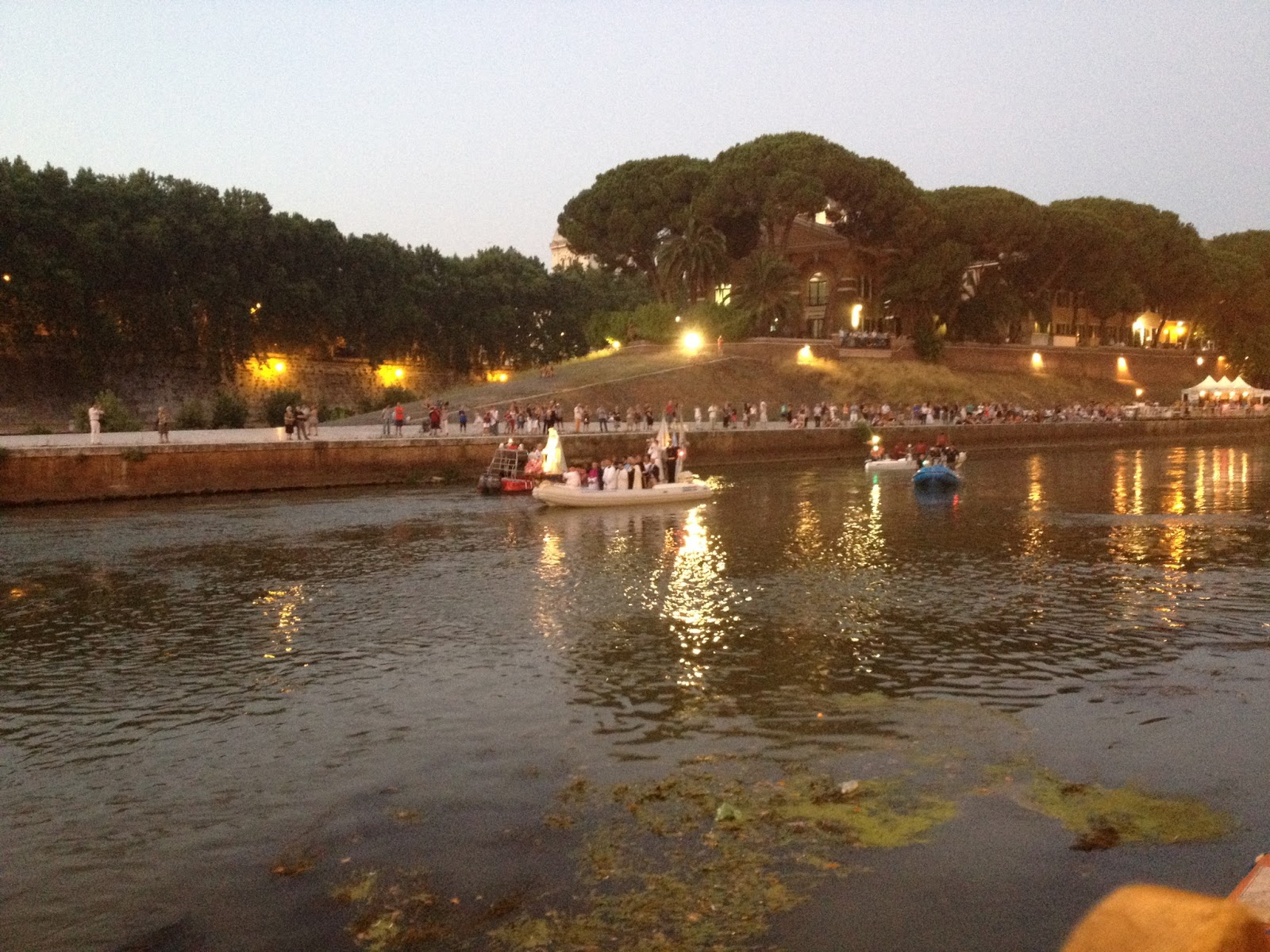
Every July, the first
Saturday after the 16th to be precise, a major 8-day festival takes
place in my beloved neighborhood to celebrate this “miraculous” statue (if you
can consider a statue be fished out of a river a miracle). The original statue
stays put in Sant’Agata (these days she’s too precious to move about), but a 19th-century
polychrome wooden copy is carried about to much fanfare and jubilation (and yes, they change her outfit every year).
Festa de' Noantri, Pza San Francesco d'Assisi, 2012
Festa de' Noantri, Pza San Francesco d'Assisi, 2012
Festa de' Noantri, Via San Francesco a Ripa, 2012
After a goodly number of
masses and benediction ceremonies, she is carried in solemn procession from
Sant’Agata to the original statue’s first home, San Crisogono. But don’t think
they just walk her across the square. That would be too easy. No, she is
carried down Via della Lungaretta, Via della Luce and into Piazza San Francesco
d’Assisi (where another celebration takes place), down Via San Francesco a Ripa,
Via Natale del Grande, Via Roma Libera, and many more streets in Trastevere,
until she is finally deposited at San Crisogono, where she stays for the
duration of the festival.
Festa de' Noantri, Via San Francesco a Ripa, 2013
Festa de' Noantri, Via San Francesco a Ripa, 2013
Festa de' Noantri, Via San Francesco a Ripa, 2013
My friend Jill watching the procession from across the street
Then the partying begins: street
concerts of traditional music (cue: Roma,nun fa’ la stupida sta sera), old folks literally dancing in the streets,
stall selling porchetta in Piazza Sonnino, bersaglieri playing their trumpets while they run (seriously impressive), and endless
shouts of “Evviva Maria!” to be heard at
any time of day or night. At the end of the festival, the pièce de resistance
is when hundreds of people line the river or stand on the bridges to watch the
Madonna float down the Tiber on a boat at sunset, from Ponte Sant’Angelo to
Ponte Garibaldi.
Madonna della Fiumarola, Ponte Garibaldi, 2012
Madonna della Fiumarola, Isola Tiberina, 2012
So why is it called the
Festa “de’ Noantri”? The word Noantri is a dialectical version of “noi altri” (us others). This was a way
the residents of Trastevere voiced their indignation at the phrase, “voi altri che abitate in altri quartieri”
(you others who live in other neighborhoods), with which they were referenced by the Roman populace. They
were considered 2nd-class citizens because they lived on the wrong
side of the tracks Tiber.
I feel very differently
about the Festa de' Noantri these days, and that has less to do with the fact
that I'm a Catholic convert (that's a story for another post), and more to do
with the fact that the procession no longer wakes me up on Sunday mornings. It
still passes under my bedroom window (although I now live in a different
apartment on a different street), but it does so around 7 o’clock on Saturday
night instead of 7 o’clock on Sunday morning, and that makes all the
difference. In fact, I’ve come to love this festival. I’m now in my 8th
year of witnessing it on my very street and it literally never gets old.
Festa de' Noantri, Piazza San Francesco d'Assini, 2012
If you happen to be in
Trastevere tonight (Wed, 24 July 2013), get over to Piazza San Francesco d'Assini, stat! A brass band is playing as I write this, and who knows? Maybe the bersaglieri
will show up with their fantastic feathered hats? I know I’ll be watching from my
window.
Visit the festival's official site for a program of processions and events.
Some things never change. Some people never lose it for their first love, some people (many Italian people, actually) can never be satisfied by anything but their mother's cooking, and I, faithful readers, will never get over the thrill of learning the meaning behind Rome's street names.
It's been a long while since I've written a post about a street name, but that doesn't mean I have lost my fascination with them. As those of you who've been following this blog for a while may remember (that is, if there's anyone out there who actually reads my street name posts; I could realistically be the only person in the world who cares), in the past I've covered, Via del Mascherone, Via del Piè di Marmo, (a personal favorite of Mozzarella Mamma), Via del Babuino, Vicolo della Spada d'Orlando, Piazza della Pigna, Via dei Giubbonari, Via dell'Arco della Ciambella, and one of the coziest, most hidden-away streets in Trastevere, Vicolo dell'Atleta. If you've ever wandered down one of these streets and wondered why it had such a funny name, Big Mask Street, Marble Foot Street, Baboon Street, Orlando's Sword Alley, and so on, well, read these posts and then you'll know.
The street I want to talk about today is another little known one, tucked away in the warren of alleys directly north of Piazza Navona: Vicolo del Leonetto. You don't have to be fluent in Italian to figure out that this street name has something to do with a lion.
I came upon this street by chance about a month ago, as I was on my way to pick up some clients at their hotel. In all likelihood I had never walked down this street before, probably because it curves in a way that makes it seem at first like a dead end. As I tramped my way from Rione Ponte into Rione Campo Marzio, and headed down this hitherto unknown street, I noticed a strange, clearly ancient piece of statuary protruding from the corner of a building, just at the point at which the alley makes its little bend.
These physical remnants of the past can be found all over this neighborhood, and as much as I delight in them, I had no time to stop and muse of this particular one. I hastened to collect my clients, and as we walked back down the street in the opposite direction, I glanced at the protruding fragment once again, but this time I noticed something that hadn't been visible from the other angle, something that looked distinctly like a mane.
And it smacked me in the face: Vicolo del Leonetto: Little Lion Alley. A surge of excitement raced through me, as always happens when I serendipitously discover the name of a Roman street, and only my innate professionalism kept me from whooping. I mean, can you stand it? For all its wars and corruption and gladiators and sacks and plagues and brawls and murder, at its heart, Rome is just too cute for words.
Is it just me, or does this little lion look a bit more like a very smiley shark from this angle?
My clients patiently
waited as I snapped a few photos of my newest find, at which point I
giddily explained to them my passion for Roman toponymy. I gushed and they pretended to be interested; it was a very special moment.
I
will leave you with this incredibly inviting doorway, about four paces beyond the lion himself. It leads no doubt
to an equally adorable apartment in which I'm sure I would be happy to spend the
rest of my days. I am a Leo, after all.
OK, my friends and bloglings, your humble correspondent, the one who extols the virtues of writing by hand and sending letters by post, is at risk of becoming a social media junkie. It probably all began around the time I succumbed to the irresistible allure of the iPhone (after swearing I would never own one, and deriding all my friends who were constantly glued to theirs--they're making fun of me right now, by the way).
But it got much, much worse when Vine happened.
What is Vine, you ask?
Well, if you're not in the know (like moi), Vine is an iPhone app owned
by Twitter, similar to Instagram, but instead of posting photos,
you post videos. Teensy videos. Six seconds, max. But the twist
is, with just the touch of your thumb--while you record--you can cut the
video so that the result is a collage of several even teensier clips.
The thing about Vine is that once you starting using it, everywhere you look (especially if you live in a visually gorgeous place like Rome, what can I say), you see an opportunity to make a Vine. Strolling through a particularly picturesque piazza at twilight? Vine it. In St. Peter's Square while white smoke is pouring out of the Sistine Chapel chimney? Vine it. Waiting for the number 23 bus while wearing fabulous tights? Vine it. Cooking up a scrumptious meal? You get the idea.
They are tiny peeks into a friend or a stranger's world, and I am afraid that I'm addicted, both to making my own and to watching others'.
Just about anything, with a little practice, can be turned into an aesthetically pleasing Vine. Except maybe excessive use of pets and babies, and trust me, there are a lot of Vines like that out there. Not that I have anything against pets or babies; they're just not that interesting in videos unless they are yours. That is, of course, unless the pet is a cat who barks or the baby is shrieking with laughter at someone ripping paper. That would be OK.
The best part about Vine is its length. Six seconds. I mean, it's brilliant! You can watch anything for six seconds. And in that sense it's the video version of Twitter: six seconds instead of 140 characters, perfect for our generation's unprecedentedly short attention span.
I just learned how to embed my Vines on my blog [pats self on back], although for some reason I can't seem to get the audio to work. I'm still a complete beginner, so bear with me!
Here are a few of my favorites. The star of these mini-videos? Rome, of course. Not that six seconds could ever do her justice.
Piazza Farnese by night
Piazza Navona at twilight
A walk from Trastevere to the Ghetto
If you too are on Vine, you can follow me at @ThePinesOfRome
Because Vine only works (for now) on the iPhone Vine app, this link will only work from an iPhone that has Vine installed on it. Hopefully that won't always be the case! In the meantime, you know I won't be able to resist posting my favorite Vines here, so stay tuned!
For those of you from the other side of the pond, the first day of May is European Labor Day and just about everyone has the day off. Like every holiday in Italy, May Day has its own traditions and customs, and in Rome it is most widely celebrated by heading out of town for a scampagnata, a country outing. This generally involves either an actual picnic on some lush hillside, preferably with a vineyard in view, or an interminable lunch in some large country osteria where every table is reserved for the entire lunch shift because table turn-over doesn't exist for these kinds of meals.
If it's not possible to make it all the way out to the country, or for those who dread the traffic, a picnic in one of Rome's many sprawling public parks is an acceptable substitute. And of course, no Italian holiday would be complete without the tradition of some specific, local, in-season ingredients. And May Day in the vicinity of Rome dictates pecorino cheese, raw fava beans, and for the non-vegetarians, some prosciutto. (And a bottle of Frascati wine, it goes without saying.)
Another May Day tradition in the city is the free mega-concert in Piazza San Giovanni in Laterano. Every year, between 800,000 and a million people fill the square to hear dozens of different performers, some very well known and most Italian. I cannot tell you what it's like as my agoraphobia would never permit me to attend, not even if I was paid to do so. To be honest, just the thought of being in that crowd makes me almost hyperventilate. But hopefully you don't share my crowd-anxiety, and if you'd like to attend, the music kicks off at 3pm and lasts until midnight.
Concertone di Primo maggio, 2011, Pza San Giovanni in Laterano [source]
I know you're all wondering, with baited breath no doubt, how your faithful correspondent chose to celebrate this made up important holiday. I'm sorry to disappoint those of you who may imagine that I have some kind of glamorous life, what with living in Rome and all, but I cannot lie to you, dear readers. My May Day has been pretty boring, although productive. I realized this morning that I have literally practically no clothes. And most importantly, I do not own a pair of jeans. Or I didn't until this morning.
I'll let you in on a little secret. I hate shopping. I mean, I really really hate it. It makes me want to throw up just thinking about it. And I especially hate it when there is something specific that I need to buy, because I will almost surely not find it. I should, perhaps, clarify this a little: I hate shopping in Italy. Shopping in the United States, if overwhelming and over-stimulating, is a wonderful, marvelous thing. But shopping in Italy--at least in 2013--is hell on Earth. Why, you ask, darling readers? Because mid-level Italian designers have decided that it's not 2013, but actually 1991. So the shops are full of baggy T-shirts, off-the-shoulder, shapeless, sweater-dresses, M C Hammer pants, and jeans that are intended to be rolled up tightly at the ankle, like we did in 8th grade. All in the attractive colors of brown, beige, and camel. Every shop looks the same and it isn't pretty. It's a wonder I found any decent jeans at all.
My second exciting May Day event was the dreaded cambio di stagione (change of season). This is when you swap out all your winter clothes for your summer clothes and hope there isn't a late spring cold-spell. (This isn't necessary where I come from, by the way. In Seattle, the temperature is more or less the same all year round.) But it is a must in Rome, where not only does the weather jump from 45 to 85 degrees Fahrenheit sometimes in the space of a few weeks, but also where almost no one has more than a puny little wardrobe (roomy, built in closets are unknown in these parts). Thank God for the soppalco (crawl space).
Jealous, right? I'll bet. But just think, if I hadn't opted for a boring May Day, I wouldn't have had the time to write this post, and that's what really matters, amirite? Um, hello? Anyone still reading?
I do want to mention my absolute best May Day ever. It was in 2010, coincidentally just after I began this blog. Here is the post I wrote about that day: Perfezione e Vergogna (before I realized using Italian titles for my posts was not the best idea if I actually wanted people to read them--silly me). It was a wonderful day that included a bike ride in Villa Pamphilj and the requisite endless lunch in the countryside with a big group of friends.
But those two highly enjoyable outings are not what made that day so special, nor are they the reasons I will remember it forever. No, that is because of something that happened early, early in the morning. Let me set the scene: I was engaged to be married. We I had decided that the wedding would take place in San Pietro in Montorio, just up the street from where I lived at the time on Via Garibaldi. The church is perched on the slope of the Gianicolo Hill, is the sight of Bramante's exquisite Tempietto, and has a view of Rome that makes you me want to weep with ecstasy.
The only problem is, just about everyone in Rome wants to get married there. I had talked to the priest months earlier and he had explained that you cannot book a date at that church any more than one year in advance, to avoid "abusi" as he put it. What did that mean for us me? I meant that we I would have to basically stake out the church on the first day of whichever month we hoped to get married in, one year in advance. And hope to get there in time to get a good date.
We had originally planned to get married some time in early June, but I wasn't sure how early we I would have to get to the church on the morning of the first of June to line up. How many other couples would have the same idea? June is probably the most popular month to get married... would I have to wait all night? (I had a vision of Claudio and I with our chess set sitting on the steps of the church on a balmy June night, waiting to pick our wedding date with all of Rome spread at our feet. Pretty romantic, right?)
But still, I was worried. I'd only have this one chance. What if 30 couples got there before us and grabbed all the weekend dates? I decided to do a dry run the month before. I figured I would show up at the church on the morning of the first of May around 6am (they let people in at 7) and see how many couples were waiting and ask them what time they got there. Well, I can tell you it wasn't easy dragging myself out of bed before six on a holiday, but luckily I lived very close to the church. I was rewarded with an incredible sight. I have seen the view of Rome from the Gianicolo probably hundreds of times (although I never tire of it), but never had I seen it at dawn. The city had a golden-rosy glow with just tinge of periwinkle. As beautiful as Rome is at sunset, I think it might be even more glorious at sunrise.
When I arrived at the church, the parking lot was full of cars. A few people were sitting around. Fourteen couples were already there, most had arrived the night before and slept in their cars. One couple had showed up at 2pm the day before. It did not bode well. June will be even worse, I imagined. Then I noticed that someone had a list. It was actually a calendar with the available days and times for weddings shown; as soon as a couple arrived, they blocked off their preferred date and waited until 7am to confirm it with the priest. I gave it a glance, just out of curiosity. All the 4pm weekend slots were already taken of course, except one: Sunday, 29 May. I thought quickly. Early June, late May, did it really make such a difference?
I jotted our names down, just in case, and made a quick call to a very sleepy fidanzatino (not yet maritino). "What? You booked what? When? All right... whatever...." Yes, it would have been nice if he had been as ecstatic as I was, but the important thing was he agreed on the date. I felt rather pathetic being the only lone bride there while everyone else was with their betrothed (except there was one groom whose fiancée was out of town and he had brought a male friend with him to keep him company; before he explained this I was thinking, "Did they change the rules?"). An hour-long wait and a quick meeting with the priest and that was it: we had a date for the wedding, in a church with one of the most amazing settings in the city. And that quiet, serendipitous morning is what May Day will always be for me.
I can't close this (very rambling) post without at least one nugget of history. Long before May Day was called by the pedestrian name of Primo maggio, it used to be called Calendimaggio. This term comes from the ancient Roman calendar, in which the first of the month was called the Kalends. As is the case with most Italian words in my vocabulary, the first time I ever heard the word Calendimaggio was in an opera. One of my favorites in fact, Puccini's Gianni Schicchi. Rinuccio and Lauretta desperately want to get married on Calendimaggio, only their families detest each other. Here's a video of the entire one-act opera, skip to 25:55 for the moment in which the thwarted couple despairs that they won't be able to marry on Calendimaggio.
I first saw this opera as a teenager I decided then and there that I too must wed on Calendimaggio. In fact, this was the original date I had hoped for, but am very happy someone talked me out of it, as John Paul II was beatified that day in 2011 and Rome was bursting to the gills with pilgrims, not to mention the traffic nightmares the Primo maggio concert inevitably causes.
In the Renaissance, Calendimaggio was not only a celebration of the arrival of spring (like May Day around the world), but it was also a day when tradition dictated that young men leave flowers at the doors of their sweethearts and maybe even serenade them. One of the few Italian cities that maintains the tradition ofCalendimaggio is Assisi, where a three-day festival takes place during the first week of May every year, with processions, concerts, theater performances, competitions and lots of local townsfolk dressed in gorgeous Renaissance costumes. It starts tomorrow!

.jpg)


.jpg)