Showing posts with label curiosities. Show all posts

Tuesday, December 20, 2016

Rome's Unsolved Mysteries


So you think you know everything there is to know about Rome? Ok, maybe that’s asking a lot. Do you believe you can find the answer to any Rome-related question with a simple Google search? Are you convinced your heaving library of books on Rome holds all the answers? Think every facet of this city’s past has been asked and answered? Well, think again. There are, in fact, many question marks that surround Rome’s fascinating history. Let’s go on a little treasure hunt of sorts to look at some of the most intriguing unanswered questions:


Pantheon Rome light shaft
The Pantheon on Rome's birthday, © Tiffany Parks

Is the Pantheon a sundial?
The Pantheon is one of the most recognizable monuments in the Eternal City and receives millions of visitors every year. Any guidebook will tell you that the temple was built by Emperor Hadrian around 126 AD, that it’s the best-preserved ancient Roman building in the city, and that the early Renaissance architects studied it for insight on building domes. Its most characteristic aspects include a coffered ceiling, the largest unreinforced concrete dome in the world, and an oculus—or open hole—in the ceiling that illuminates the dark interior with dramatic shafts of light.
But recent studies have hypothesized that the iconic site is even more than meets the eye. Historians Robert Hannah and Giulio Magli claim that the true purpose of the Pantheon was nothing less than an enormous sundial, having been oriented so that the sunbeam from the oculus lights up certain areas of the interior at significant times of the year. And in fact, the light beam shines directly out the door at noon on 21 April, the legendary founding of the city, and in other striking ways on solstices and equinoxes. Other scholars disagree, saying that the purpose of the oculus was to cool the building in the heat of summer, or lighten the weight of the immense dome to prevent collapse. But without concrete evidence, the true purpose of the Pantheon will remain one more of Rome’s unsolved mysteries.
Piazza della Rotonda. Open Mon–Sat, 9am–7:30pm; Sun, 9am–6pm.
 
Basilica Neopitagorica


What was the Basilica Neopitagorica used for?
Located directly below the tracks of a railroad line that connects Rome and Naples and buried entirely underground, the Basilica Neopitagorica is one of the most mysterious and little-known sites in the city. The mysterious building lies nearly nine meters under Via Prenestina, and is laid out in the classical basilica plan, with three naves, an apse, an atrium, and a dromos. The barrel-vaulted ceilings are decorated with stucco reliefs depicting mystic symbols, the floors are covered with traces of black and white mosaics, and frescoes along the walls depict scenes from Greek mythology.
But no one knows for sure what this cryptic space was used for, and multiple theories have been put forth since its accidental discovery in 1917. Some claim it was a nymphaeum, others insist it was a mausoleum or funerary complex dating to the late-Augustan period. The most widely held belief is that it was a sanctuary of the Neo-Pythagorean cult, a philosophic and religious movement inspired by the teachings of the Greek thinker Pythagoras. The cult eventually died out in favor of Neo-Platonism, and the basilica appears to have been destroyed during the reign of Emperor Claudius.
Although it is now entirely excavated, the site has long been inaccessible to the public, mostly due to its precarious position beneath the railway line. However, it opened its doors for a limited series of visits this past fall, and although those visits are now over, we can only hope that they decide to do so again in the near future. Especially as this one’s on my bucket list.
Piazzale Labicano. www.coopculture.it

 
San Lorenzo Fuori le Mura


Is the Holy Grail in Rome?
Everyone knows the story of the mystical Holy Grail and the numerous lifelong quests to discover its location, or even confirm its very existence. From King Arthur to the Knights Templar to Indiana Jones, every great adventurer has dreamed of holding the sacred chalice in his hands. But what if this most sought-after of artifacts were right here in Rome, under our very noses? That’s what archeologist Alfredo M. Barbagallo claims. Christian tradition would have it that the treasures of the early church were entrusted to St. Lawrence by Pope Sixtus II in 258 AD. Was it a coincidence that the saint was martyred just four days later (famously grilled alive) during the persecution of Emperor Valerian? Barbagallo says no. He believes that St. Lawrence took the grail with him to his grave, on top of which was built a small shrine, and later the Basilica San Lorenzo Fuori le Mura. Go ahead and visit for yourself, but keep in mind that the catacombs under the church remain sealed. Until they are opened, we’ll never know for sure.
Piazzale del Verano, 3. Open daily, 7:30am–12:30pm and 3:30–7pm.

 
The Colosseum by night, © Alessandro Silipo


Is Rome truly haunted?
In a city that has seen as much death as Rome has, there are bound to be a few ghosts flying around. From the thousands of people slaughtered in the Colosseum, to the medieval plagues that carried away 90% of the population to the Sack of Rome of 1527 that claimed up to 12,000 lives, the scent of death has been a constant in the Eternal City since its inception. For centuries, it was believed that the Colosseum was one of the seven portals to hell, rife with demons. Artist Benvenuto Cellini wrote in the 16th century of his experience consulting with a necromancer at the Colosseum, seeking to discover the fate of his missing lover. As late as the turn of the last century, the Colosseum was thought to be so polluted by the noxious fumes of its countless murders as to be fatal to anyone who breathed them, particularly at night. (Just read Henry James’ Daisy Miller if you don’t believe us.) Decide for yourself if it’s truly haunted by taking an after-hours tour, but don’t say I didn’t warn you.
Piazza del Colosseo, 1. www.coopculture.it
Want more solid proof of the existence of ghosts? Pay a visit to the Museum of the Souls in Purgatory, a tiny museum that displays messages from beyond the grave: fingerprints burned into prayer books, a charred handprint on a wooden table, and other creepy evidence that heaven’s unpleasant waiting room might actually exist.
Lungotevere Prati, 12. Open 7:30–11am and 3:30–7:30pm.


David Oakes as Juan Borgia and Francois Arnaud as Cesare Borgia in Showtime's series, The Borgias


Did Cesare Borgia kill his brother?
The infamous Borgia clan: they were rich, powerful, corrupt, violent, and Spanish. Led by the charismatic and sensual patriarch Rodrigo Borgia, who was elected Pope Alexander VI in 1492, they were the most hated and feared family in Renaissance Rome. Scandal followed wherever they went, and not without good reason. The Pope had at least 11 illegitimate children and celebrated his ascension to the throne of St. Peter by acquiring a new teenaged mistress. Two of his children, Cesare and Lucrezia, were accused of having an incestuous relationship, and his Master of Ceremonies Johannes Burkhart reported elaborate orgies taking place inside the Pope’s apartments. But by far the greatest scandal of his papacy was the death of the family golden child, Juan Borgia, when his body mysteriously washed up on the shores of the Tiber with its throat slit and nine stab wounds to its torso. He was hated by so many people that it was impossible to identify a killer, although many scholars believe one of his own brothers did the deed, most likely Cesare, jealous of their father’s favor and their sister’s affections. After more than 500 years, the trail has gone a bit cold, and it’s unlikely we’ll ever know for sure who killed Juan Borgia. But a visit to the Borgia Apartment (part of the Vatican Museums), with the nefarious family members immortalized in frescoes by Pinturicchio, will make the mystery come alive. And keep your eyes peeled for the trap door that reportedly exists somewhere within it, a hatch that emptied directly into the Tiber, making it all too easy for the Pope to dispose of his enemies.
Viale Vaticano. Open Mon–Sat, 9am–4pm. www.vatican.va
 
 
Pope John Paul I, August 1978

Pope John Paul I, September 1978


Was John Paul I murdered?
A slightly more recent Vatican whodunit concerns the fate of Pope John Paul I, whose pontifical reign lasted a mere 33 days. Elected on 26 August 1978, he was found dead in the early hours of the morning of 29 September, barely a month later. Official Church spokespeople insisted his death was natural, although some reported heart attack and others said pulmonary embolism, others still claimed an accidental overdose of his medications. It would later be impossible to confirm, as his body was embalmed immediately, with no autopsy. Not only that, but the Pope had no history of heart issues, his personal items disappeared, never to be seen again, and it eventually came out that the nun who had discovered his body was placed under a vow of silence. Many suggest there was, in fact, a more sinister explanation behind his untimely demise, perhaps because Papa Luciani (as he was affectionately known) did not always adhere to the conservative Vatican line, and his fervent goal was to rid the echelons of the Church of its wealth and power. Not very convenient for the big dogs in the Vatican curia. To learn more, pick up a copy of In God’s Name, a work of nonfiction by investigative journalist David Yallop.


Johanna Wokalek as the title character in Pope Joan (Constatin Film)


Was there really a female pope?
A mystery that is sure to remain unsolved, probably for all time, is that of Pope Joan, the supposed female pope. The story goes that, during the early Middle Ages—the 9th century according to most accounts—a young Saxon woman who was unusually well educated for the time, disguised herself as a man and became a monk. She later travelled to Rome where she ascended the church hierarchy and was eventually elected pope. She ruled for two and a half years, but was discovered when she gave birth unexpectedly during a papal procession, and died shortly thereafter. The earliest reports of this extraordinary tale don’t appear until the 13th century, and for this reason, many naysayers reject the story out of hand. But while the story of “la papessa” officially holds legend status, there are those who wholeheartedly believe she existed. Their number one piece of evidence is a wooden chair—reportedly hidden away in the archives of the Vatican Museums—with a keyhole shape cut out of its seat. During the middle Ages, newly elected popes would be asked to sit on the chair, while a cardinal checked to make sure they were indeed male. Intrigued? Pick up Donna Woolfolk Cross’s historical novel Pope Joan, or the 2009 film based on the same.


StumbleUpon Pin It

Friday, October 4, 2013

Five Ways to Celebrate St. Francis’s Feast Day in Italy


The Day after Pope Francis's election, Piazza San Francesco a Ripa. ©Tiffany Parks

Since I live on a street dedicated to St. Francis of Assisi, and since I can see a church dedicated to St. Francis of Assisi right out my bedroom window, and since my darling Maritino and I were married by a Franciscan priest, and since our current ever more lovable Pope chose his papal name (many believe) to honor St. Francis of Assisi, I figured it would be a good idea to write a little post today on 4 October, on occasion of the feast day of one of Italy’s all-time best-loved saints.

Instead going into St. Francis’s life andworks, which I’m guessing most people are already familiar with, I thought I’d suggest five ways to celebrate his feast day, and five different Italian cities in which to do it.

Assisi

Basilica of San Francesco d'Assisi, Assisi. [source]

As the saint’s hometown, this is the obvious choice. In fact, this is where Pope Francis himself decided to celebrate St. Francis’s Day, so expect a lot of crowds if you choose this option. Besides the sheer majesty of the 13th-century basilica, one of the most important fresco cycles of the great Giotto di Bondone, and in fact one of the most celebrated works of art of that magical period when the buds of medieval art began to blossom into the Renaissance. 

The Woman's Confession, Giotto. Basilica of San Francesco d'Assisi, Assisi. [source]

The Dream of the Palace, Giotto. Basilica of San Francesco d'Assisi, Assisi. [source]


San Francis receives the Stigmata, Giotto. Basilica of San Francesco d'Assisi, Assisi. [source]

The 28 frescoes that line the lower section of the nave of the Basilica of San Francesco d’Assisi tell the story of the saint’s life and are believed to have been painted between 1296 and 1304. Bonus: an even earlier portrait of St. Francis, by late-medieval master Cimabue, can be seen on the transept wall. The fresco, Our Lady Enthroned with St. Francis, dates to 1280 and features one of the most well known depictions of the saint.


Our Lady Enthroned with St. Francis, Cimabue. Basilica of San Francesco d'Assisi, Assisi. [source]

The basilica also contains the saint’s tomb.

Tomb of St. Francis of Assisi. Basilica of San Francesco d'Assisi, Assisi. [source]


Florence

Basilica of Santa Trinità, Florence. [source]

If you prefer high Renaissance art to late medieval/early Renaissance crossover art, and you happen to be in Florence today, you’re in luck! Head to Santa Trinità church where you can visit the Sassetti Chapel, containing an exquisite fresco cycle by Domenico Ghirlandaio (who just happened to be Michelangelo’s first master, and one of the painters of the walls of the Sistine Chapel). The fresco, dating from 1482-1485, depict several scenes of St. Francis’s life, including the receiving of the stigmata, the confirmation of Franciscan rule, and the resurrection of a boy.

Confirmation of Franciscan Rule, Ghirlandaio. Church of Santa Trinità, Florence. [source]

St. Francis's Trial by Fire, Ghirlandaio. Church of Santa Trinità, Florence. [source]


Death of St. Francis of Assisi, Ghirlandaio. Church of Santa Trinità, Florence. [source]

Chiusi della Verna

Santuario della Verna, Chiusi della Verna. [source]

Not many tourists make it to this tiny little town in the province of Arezzo, but if you’re in the general area today, consider a visit to the Santuario della Verna, just a few miles outside of town. In addition to its evocative setting, perched on an outcropping of Mount Penna, the sanctuary is also renowned for being the site at which St. Francis received the stigmata, on 14 September 1224. You can also visit a small museum attached to the sanctuary where you can see St. Francis’ rough habit, slightly moth-eaten, but still intact.

Habit of St. Francis of Assisi, Santuario della Verna, Chiusi della Verna. [source]


Subiaco

St. Benedict's Monastery, Subiaco. [source]

This gorgeous hilltop town, famous for its medieval Benedictine monasteries, is not generally associated with St. Francis of Assisi, but there is one notable curiosity for those seeking to pay homage to the saint today. In St. Gregory’s Chapel in the Monastery of St. Benedict is only known portrait of St. Francis painted during his lifetime. The portrait shows neither halo nor stigmata, showing it was indeed painted before the saint’s death in 1226. If you want an idea of what he actually looked like, this is probably as close as you’ll come.

Portrait of St. Francis of Assisi, St. Gregory's Chapel, St. Benedict's Monastery, Subiaco. [source]


Rome


Church of San Francesco a Ripa, Rome. ©Tiffany Parks
 
If you’re in the Eternal City today, never fear! You don’t have to travel anywhere if you want to make a St. Francis pilgrimage of your own. The church of San Francesco a Ripa in Trastevere is attached to a convent that housed St. Francis when he was in Rome in 1209 seeking recognition of his order by Pope Innocent III. If you ask the custodian nicely (and if your shoulders and knees are modestly covered!) he’ll happily take you up to the very cell St. Francis slept in, complete with the very stone he used for a pillow, which visitors are allowed to touch.

The rock St. Francis used as a pillow, Cell of St. Francis of Assisi, Church of San Francesco a Ripa, Rome. [source]


While you visit the church (which by the way also contains Bernini’s late masterpiece The Ecstasy of the Beata Ludovica Albertoni), take a moment to wallow bitterly in the knowledge that this unassuming little trasteverina church once contained, along the walls of the nave, the prototype of the legendary Giotto cycle in Assisi. The frescoes depicting scenes from the life of St. Francis, attributed to Pietro Cavallini, are sadly now lost. “Now lost”: two words that inspire the wrenching of hearts and gnashing of teeth of many an art lover.
StumbleUpon Pin It

Wednesday, July 24, 2013

La Festa de' Noantri, the festival of the Trasteverini


Festa de' Noantri procession, 1950s [source] 


I remember that morning like it was yesterday: a bright mid-summer dawn, just weeks after moving into my dream Trastevere apartment. In a haze of grogginess and not enough sleep, I hear a booming, nasal voice. It's Sunday and seems impossibly early for whatever is happening, especially as it's happening right outside my bedroom window. 


I bury my head in my pillow as I hear a monotone voice bleating out of a loudspeaker. Yes, a loudspeaker. A half-blind glance at my phone shows it’s not even 7am. "...Madre di Dio, prega per noi peccatori..."

Madre di Dio, what the...?

This I had to see. I flop out of bed and stumble over to the window. "Ave Maria, piena di grazia..." the voice drones on. Opening the shutters, I peer below.


Festa de' Noantri, Via Garibaldi, 2010, Crazy o'clock AM

Festa de' Noantri, Via Garibaldi, 2010

Festa de' Noantri, Via Garibaldi, 2010

A procession, a full-on religious procession, was trundling past my window. There were priests, altar boys, a smattering of older ladies in somber dress. They were all doing a call-and-repeat version of the Ave Maria that I have since become much more familiar with. Oh, and they were carrying a gigantic statue of the Virgin Mary on their shoulders. One thing I have learned living in Italy is that Italians love the Virgin Mary. I mean, they love her more than Jesus. Or so it seemed to my then-non-Catholic self. I had almost literally stumbled upon the Festa de’ Noantri.

The pictures I've included here were not, of course, taken that morning, but four years later, when I was sadly packing up to leave that very same apartment and knew I was going to miss everything about it (besides the landlord).  Little did I know then that my new apartment would be on the self-same procession route. It’s actually not so improbable; the Festa de’ Noantri procession goes down practically every street in Trastevere.

For a little bit of historical background (and a break from my nonsensical reminiscing), the festival dates back to 1535 when, after a storm, a cedar statue of the Madonna was fished out of the Tiber (on the Trastevere side, let it be noted!). Exactly where the statue came from is still a mystery, but where it ended up is not. It was donated to the order of the Carmelites, and hence it became known as the Madonna del Carmine (although many still refer to it as the Madonna della Fiumarola, since it was found in the river). The statue was kept in San Crisogono, an ancient church in Piazza Sonnino, and was immediately considered the protectress of the trasteverini. The statue was eventually transferred to the unassuming church of Sant’Agata, right across the square.

Every July, the first Saturday after the 16th to be precise, a major 8-day festival takes place in my beloved neighborhood to celebrate this “miraculous” statue (if you can consider a statue be fished out of a river a miracle). The original statue stays put in Sant’Agata (these days she’s too precious to move about), but a 19th-century polychrome wooden copy is carried about to much fanfare and jubilation (and yes, they change her outfit every year). 

Festa de' Noantri, Pza San Francesco d'Assisi, 2012

Festa de' Noantri, Pza San Francesco d'Assisi, 2012

Festa de' Noantri, Via San Francesco a Ripa, 2012

After a goodly number of masses and benediction ceremonies, she is carried in solemn procession from Sant’Agata to the original statue’s first home, San Crisogono. But don’t think they just walk her across the square. That would be too easy. No, she is carried down Via della Lungaretta, Via della Luce and into Piazza San Francesco d’Assisi (where another celebration takes place), down Via San Francesco a Ripa, Via Natale del Grande, Via Roma Libera, and many more streets in Trastevere, until she is finally deposited at San Crisogono, where she stays for the duration of the festival.

Festa de' Noantri, Via San Francesco a Ripa, 2013

Festa de' Noantri, Via San Francesco a Ripa, 2013

Festa de' Noantri, Via San Francesco a Ripa, 2013

My friend Jill watching the procession from across the street

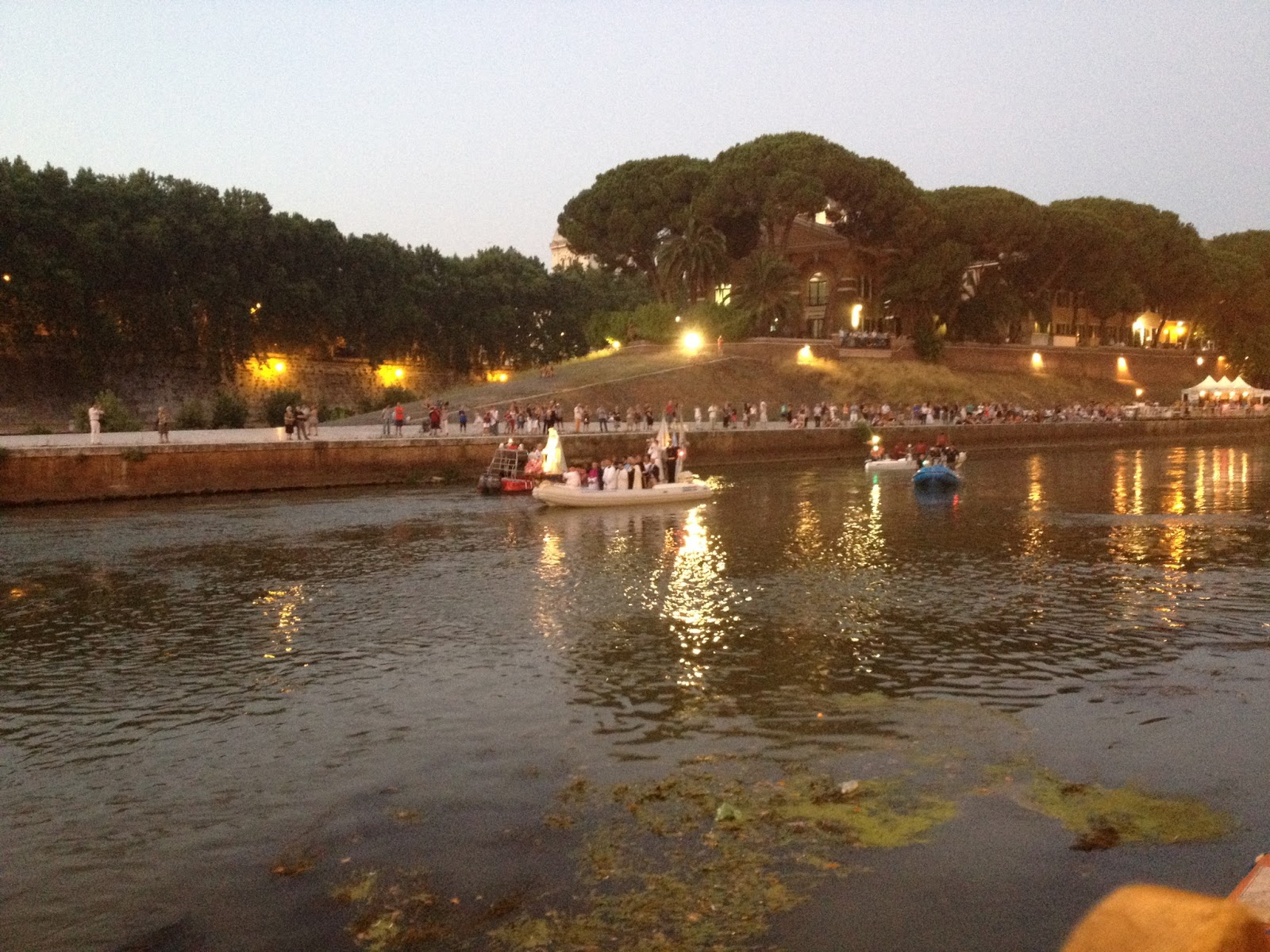
Then the partying begins: street concerts of traditional music (cue: Roma,nun fa’ la stupida sta sera), old folks literally dancing in the streets, stall selling porchetta in Piazza Sonnino, bersaglieri playing their trumpets while they run (seriously impressive), and endless shouts of “Evviva Maria!” to be heard at any time of day or night. At the end of the festival, the pièce de resistance is when hundreds of people line the river or stand on the bridges to watch the Madonna float down the Tiber on a boat at sunset, from Ponte Sant’Angelo to Ponte Garibaldi.

Madonna della Fiumarola, Ponte Garibaldi, 2012

Madonna della Fiumarola, Isola Tiberina, 2012

So why is it called the Festa “de’ Noantri”? The word Noantri is a dialectical version of “noi altri” (us others). This was a way the residents of Trastevere voiced their indignation at the phrase, “voi altri che abitate in altri quartieri” (you others who live in other neighborhoods), with which they were referenced by the Roman populace. They were considered 2nd-class citizens because they lived on the wrong side of the tracks Tiber. 

I feel very differently about the Festa de' Noantri these days, and that has less to do with the fact that I'm a Catholic convert (that's a story for another post), and more to do with the fact that the procession no longer wakes me up on Sunday mornings. It still passes under my bedroom window (although I now live in a different apartment on a different street), but it does so around 7 o’clock on Saturday night instead of 7 o’clock on Sunday morning, and that makes all the difference. In fact, I’ve come to love this festival. I’m now in my 8th year of witnessing it on my very street and it literally never gets old.

Festa de' Noantri, Piazza San Francesco d'Assini, 2012

If you happen to be in Trastevere tonight (Wed, 24 July 2013), get over to Piazza San Francesco d'Assini, stat! A brass band is playing as I write this, and who knows? Maybe the bersaglieri will show up with their fantastic feathered hats? I know I’ll be watching from my window.


Visit the festival's official site for a program of processions and events. 

All photos (except first) by author.

StumbleUpon Pin It

Saturday, May 25, 2013

The Streets of Rome: Vicolo del Leonetto

Some things never change. 

Some people never lose it for their first love, some people (many Italian people, actually) can never be satisfied by anything but their mother's cooking, and I, faithful readers, will never get over the thrill of learning the meaning behind Rome's street names.


It's been a long while since I've written a post about a street name, but that doesn't mean I have lost my fascination with them. As those of you who've been following this blog for a while may remember (that is, if there's anyone out there who actually reads my street name posts; I could realistically be the only person in the world who cares), in the past I've covered, Via del Mascherone,  Via del Piè di Marmo, (a personal favorite of Mozzarella Mamma), Via del Babuino, Vicolo della Spada d'Orlando, Piazza della Pigna, Via dei Giubbonari, Via dell'Arco della Ciambella, and one of the coziest, most hidden-away streets in Trastevere, Vicolo dell'Atleta. If you've ever wandered down one of these streets and wondered why it had such a funny name, Big Mask Street, Marble Foot Street, Baboon Street, Orlando's Sword Alley, and so on, well, read these posts and then you'll know.

The street I want to talk about today is another little known one, tucked away in the warren of alleys directly north of Piazza Navona: Vicolo del Leonetto. You don't have to be fluent in Italian to figure out that this street name has something to do with a lion. 

I came upon this street by chance about a month ago, as I was on my way to pick up some clients at their hotel. In all likelihood I had never walked down this street before, probably because it curves in a way that makes it seem at first like a dead end. As I tramped my way from Rione Ponte into Rione Campo Marzio, and headed down this hitherto unknown street, I noticed a strange, clearly ancient piece of statuary protruding from the corner of a building, just at the point at which the alley makes its little bend.


These physical remnants of the past can be found all over this neighborhood, and as much as I delight in them, I had no time to stop and muse of this particular one. I hastened to collect my clients, and as we walked back down the street in the opposite direction, I glanced at the protruding fragment once again, but this time I noticed something that hadn't been visible from the other angle, something that looked distinctly like a mane. 

 
And it smacked me in the face: Vicolo del Leonetto: Little Lion Alley. A surge of excitement raced through me, as always happens when I serendipitously discover the name of a Roman street, and only my innate professionalism kept me from whooping. I mean, can you stand it? For all its wars and corruption and gladiators and sacks and plagues and brawls and murder, at its heart, Rome is just too cute for words.

 
Is it just me, or does this little lion look a bit more like a very smiley shark from this angle?

My clients patiently waited as I snapped a few photos of my newest find, at which point I giddily explained to them my passion for Roman toponymy. I gushed and they pretended to be interested; it was a very special moment.

I will leave you with this incredibly inviting doorway, about four paces beyond the lion himself. It leads no doubt to an equally adorable apartment in which I'm sure I would be happy to spend the rest of my days. I am a Leo, after all.


All photos by author
StumbleUpon Pin It
Related Posts Plugin for WordPress, Blogger...