Showing posts with label Renaissance painting. Show all posts

Sunday, March 9, 2014

Rome's Truly Hidden Gems: The Convent of Santa Francesca Romana


Let me preface this post by saying that you know you're an art nerd when you get so excited about the once-a-year display of the frescoes of a little-known early Renaissance painter that you get up at 6:30 on a Sunday to see them (even when you've seen them twice before). So yes, I qualify. What about you? If you go nuts about Renaissance art, and you love to discover art that few people ever get the chance to see, then today is your lucky day.

Only in Rome, a city so bursting with artistic and archeological treasures that a lifetime is literally not enough to see them all, could there exist so many untold masterpieces hiding behind closed doors. Take a stroll through the historic center, and chances are a dozen or more world-class works of art will be just beyond your grasp, hidden away in private collections, deconsecrated churches, or impregnable palaces.

One place where this is definitely the case is the convent of Santa Francesca Romana. Just around the corner from bustling Piazza Venezia, and a few steps from the imposing Theater of Marcellus, the dull, brown two-story building is unlikely even to spark your attention, let alone hint at the wonders lurking inside. Closed to the public 364 days of the year, not many visitors to Rome are granted access to its marvels, but if you happen to be in town on 9 March, you are in luck.

Santa Francesca Romana was a 15th-century Roman wife, mother, and noblewoman. Despite her elevated station in life, she was known for her humility, piety, and strength of faith in the face of a number of personal tragedies. She founded the religious institution the Oblate di Tor de’ Specchi, where she became the Mother Superior after her husband’s death, and was later canonized by Pope Paul V. Nearly 6 centuries later, the 9 March passing of this well-loved Roman lady is remembered every year with the one-day opening of her convent to the public.

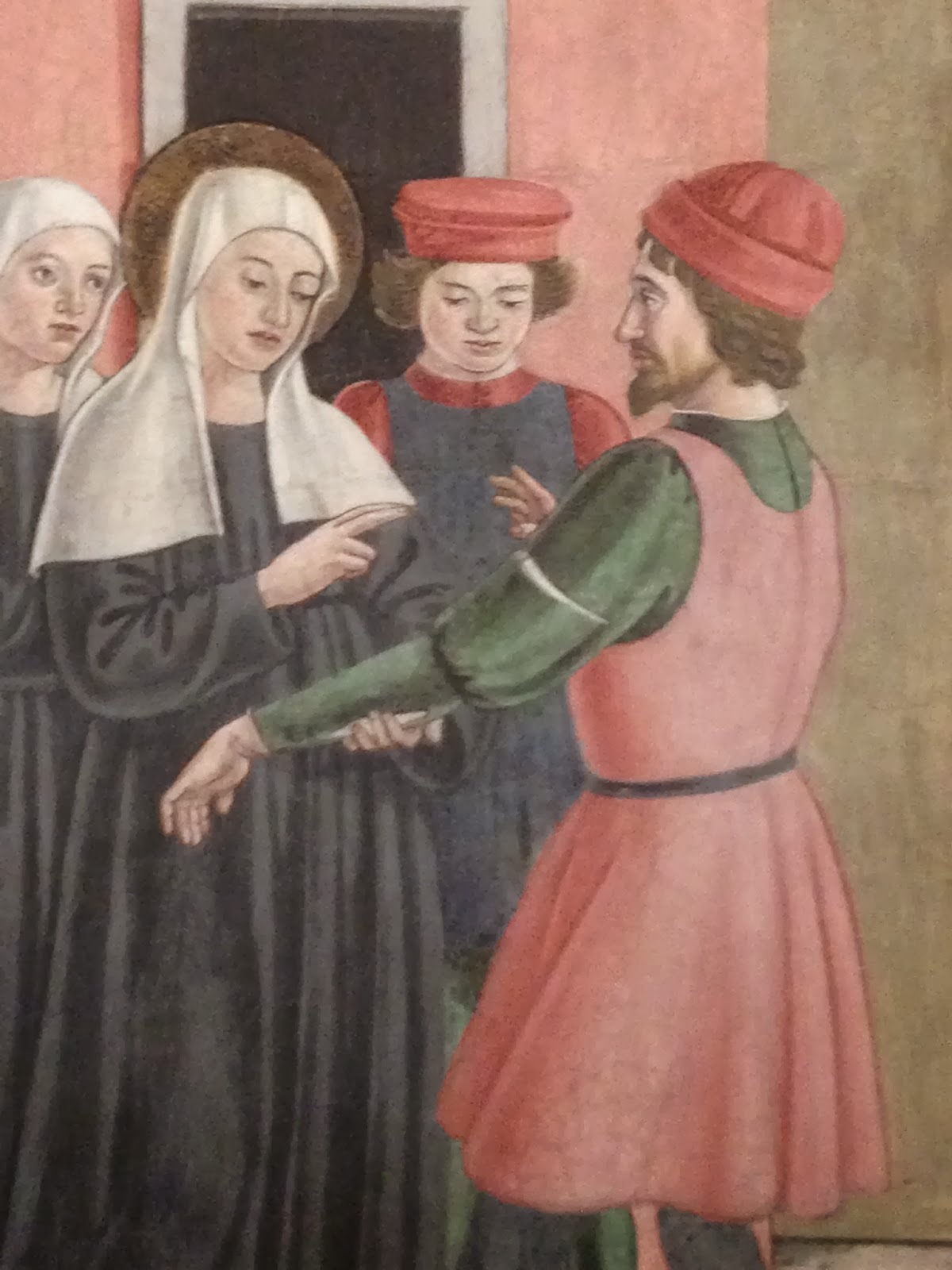
Don’t let the line stretching down the street discourage you from visiting this extraordinary site. Unlike many medieval buildings in Rome, the remarkable convent is completely untouched by the advances of time. The interior walls were frescoed in 1468 by Antoniazzo Romano, now considered the first great Renaissance artist of the Roman school. The 25 bright and detailed panels, entirely covering the walls of the main room, depict scenes from the life of the saint and provide an important visual testimony to urban 15th-century Rome. To the further delight of historians, each panel is accompanied by a caption written in an early example of Rome’s vernacular dialect.

Don’t miss this chance to see this well-preserved example of early Renaissance art in Rome, one of the city’s truly hidden gems. But my advice is to get there early. Since 9 March falls on a Sunday this month, there are likely to be bigger crowds!

Here are a few images I snapped last year.


Santa Francesca Romana was quite the healer. These frescoes are bloody, but in a good way. And it seems that everyone who had contact with the saint had a happy ending.


 Has this guy just gotten his legs waxed? Call me silly, but that is truly what it looks like.


9 March. 8:30am­–12:30pm and 2:30–7:30pm. Via del Teatro di Marcello, 32. Tel 066797135. Free entry.

StumbleUpon Pin It

Tuesday, February 18, 2014

Michelangelo's Rome, 450 Years Later

What better way to celebrate Michelangelo's long life and immense body of work, than spending the 450th anniversary of his death taking a tour of his works. If you're lucky enough to be in his hometown of Florence today, you'll have even more opportunity to do so. But here in Rome, where Michelangelo lived and worked for much of his life, there's still a lot to see.

It is not often that one of an artist's earliest works becomes appreciated as one of his greatest masterpieces, but such is the case with the Pietà, sculpted in the last years of the 15th century, when Michelangelo was barely 25 years old.

Detail of the Pietà, Michelangelo, St. Peter's Basilica, Rome [source]

So much could be––and has been––said about this work, that I can't even scratch the surface in this little post, so I won't try. One curiosity is that it is the only work that Michelangelo ever signed, according to legend because he was frustrated that he was not receiving the proper recognition for the work, as he was new to Rome when he created it, and not yet well known there. He did this in secret, after the work had been completed and presented, and in fact, he was in such a hurry that he made a few mistakes! If you look closely you can see that he even misspelled his own name, leaving out a few letters and inserting them inside of others. I guess no one is perfect, although he came as close as anyone on Earth ever did, I'd wager.

Detail of the Pietà, signature, Michelangelo, St. Peter's Basilica [source]

After a stint in Florence, during which Michelangelo sculpted the David, he was back in Rome and working, against his will, on the ceiling of the Sistine Chapel, from 1508 to 1512. There are probably close to 7 trillion blog posts about the Sistine Chapel, so I won't bore you with another, but I will post my absolute favorite image from the ceiling. This glorious lady is the Libyan Sybil, called Phemonoe, who foretold of the "coming of the day when that which is hidden will be revealed." I have stood in the Sistine Chapel over one thousand times, and of the some three hundred figures on the ceiling, this is the one that has struck me over and over.


The Libyan Sybil, detail from the ceiling of the Sistine Chapel, Michelangelo  [source]

Sometimes looking at a great artist's plans and sketches is more revealing that looking at the finished version. Here are Michelangelo's studies for the Libyan Sybil.


Studies for the Libyan Sybil, Michelangelo [source]


The great tragedy of Michelangelo's life was that, due to forces beyond his control, he was never given the time and space to complete the tomb of Pope Julius II, the work that he believed was going to make his career and put him on the map. He of course couldn't know that he would one day be remembered as one of the greatest––if not the greatest––artists who ever lived, and he didn't need the tomb to prove that. His only completed figure of the planned tomb is the Moses, and it is only by standing in front it that you can get a true sense of its power and majesty. It is almost unbelievable that Michelangelo made drastic changes to this work, specifically changing the positioning of the left leg.

Moses, Michelangelo, San Pietro in Vincoli church, Rome [source]

I love this whimsical drawing of what it might have been like to witness Michelangelo at work on the Moses. Somehow I doubt he would have had knights and nobles loitering around his studio while he worked, and since the work was sculpted between 1513 and 1515, this image makes the artist look a little old. But it does give you the idea of the size of the great work.


[source]

It's impossible to call any work by Michelangelo "little known," but in Rome, at least this one might come close. After delighting in Gian Lorenzo Bernini's Elefantino in the piazza outside, venture inside the glorious Gothic church of Santa Maria sopra Minerva (with its starry blue ceiling that looks something like what the ceiling of the Sistine Chapel looked like before our hero got his hands on it), to find the Risen Christ, sculpted by Michelangelo between 1519 and 1521.


The Risen Christ, Michelangelo, Santa Maria sopra Minerva church, Rome [source]

From 1536 to 1541, Michelangelo found himself back in the Sistine Chapel frescoing another colossal work of art. The Last Judgement is about as different from the chapel's ceiling as one work can be from another by the same artist. Sadly, by the 1530s, the Renaissance was over, and the Counter Reformation had come to Rome. What did that mean for art? Lots of hell and damnation to scare those naughty Protestants into coming back to the Mother Church. And it also meant that shortly after Michelangelo's death, this work would be vandalized by Daniele da Volterra (but don't blame him; he was forced to do it), who added lots of scarves and other modest coverings to some of the more scandalous figures.


The Last Judgement, Michelangelo, Sistine Chapel [source]

Don't forget that Michelangelo was not only a sculptor and a frescoist; he was an architect too. Talk about a Renaissance man! From 1536 to 1546, more or less the same period he was working on The Last Judgement, Michelangelo was also redesigning the entire Capitoline Area, reversing the orientation of the square so that it turned its back on the ancient ruins of Rome's past, and looked instead toward the Vatican, and providing the Palazzo Senatorio with a new Renaissance facade. He also designed the glorious starburst pavement in the center of the square (which I love so much that I chose it as my wedding symbol), and which was not actually laid out as Michelangelo had desired until 1940.

Piazza del Campidoglio, Michelangelo, Rome [source]

In 1547, Michelangelo began designs for the dome of St. Peter's Basilica. This would be his last major work, and for the twelve years that he worked on it, he refused to receive any payment. He realized that his life was drawing to a close, and he chose to create this masterpiece for the glory of God alone, as a kind of final offering. Although the dome was not completed until after his death, his designs were adhered to with only a few exceptions.

Dome of St. Peter's Basilica, Michelangelo [source]

Michelangelo's very last project, built between 1562 and his death in 1564, is the church of Santa Maria degli Angeli e dei Martiri, an ingenious structure in which he created a Renaissance church out of a section of the ruins of the Roman bath complex, the Terme di Diocleziano. It is a stunning place to visit, however, some unfortunate "restorations" in 1749 by Luigi Vanvitelli take away significantly from the simple harmony of Michelangelo's design.

Santa Maria degli Angeli e dei Martiri, Michelangelo, Rome [source]

This list is not quite conclusive of the works by Michelangelo in Rome. To be exhaustive, I'd have to add Palazzo Farnese, a project Michelangelo took over after Antonio da Sangallo, the arch of Via Giulia, that was originally meant to be a private bridge across the Tiber, just for the Farnese family, to link their palace with their "country" home, Villa Farnesina, and of course the magnificent frescoes in the Pauline Chapel in the Vatican. The Pauline Chapel is, alas, not open to the public and its unlikely that it ever will be, as it is the pope's private chapel. But we can dream, right?


StumbleUpon Pin It

Friday, October 4, 2013

Five Ways to Celebrate St. Francis’s Feast Day in Italy


The Day after Pope Francis's election, Piazza San Francesco a Ripa. ©Tiffany Parks

Since I live on a street dedicated to St. Francis of Assisi, and since I can see a church dedicated to St. Francis of Assisi right out my bedroom window, and since my darling Maritino and I were married by a Franciscan priest, and since our current ever more lovable Pope chose his papal name (many believe) to honor St. Francis of Assisi, I figured it would be a good idea to write a little post today on 4 October, on occasion of the feast day of one of Italy’s all-time best-loved saints.

Instead going into St. Francis’s life andworks, which I’m guessing most people are already familiar with, I thought I’d suggest five ways to celebrate his feast day, and five different Italian cities in which to do it.

Assisi

Basilica of San Francesco d'Assisi, Assisi. [source]

As the saint’s hometown, this is the obvious choice. In fact, this is where Pope Francis himself decided to celebrate St. Francis’s Day, so expect a lot of crowds if you choose this option. Besides the sheer majesty of the 13th-century basilica, one of the most important fresco cycles of the great Giotto di Bondone, and in fact one of the most celebrated works of art of that magical period when the buds of medieval art began to blossom into the Renaissance. 

The Woman's Confession, Giotto. Basilica of San Francesco d'Assisi, Assisi. [source]

The Dream of the Palace, Giotto. Basilica of San Francesco d'Assisi, Assisi. [source]


San Francis receives the Stigmata, Giotto. Basilica of San Francesco d'Assisi, Assisi. [source]

The 28 frescoes that line the lower section of the nave of the Basilica of San Francesco d’Assisi tell the story of the saint’s life and are believed to have been painted between 1296 and 1304. Bonus: an even earlier portrait of St. Francis, by late-medieval master Cimabue, can be seen on the transept wall. The fresco, Our Lady Enthroned with St. Francis, dates to 1280 and features one of the most well known depictions of the saint.


Our Lady Enthroned with St. Francis, Cimabue. Basilica of San Francesco d'Assisi, Assisi. [source]

The basilica also contains the saint’s tomb.

Tomb of St. Francis of Assisi. Basilica of San Francesco d'Assisi, Assisi. [source]


Florence

Basilica of Santa Trinità, Florence. [source]

If you prefer high Renaissance art to late medieval/early Renaissance crossover art, and you happen to be in Florence today, you’re in luck! Head to Santa Trinità church where you can visit the Sassetti Chapel, containing an exquisite fresco cycle by Domenico Ghirlandaio (who just happened to be Michelangelo’s first master, and one of the painters of the walls of the Sistine Chapel). The fresco, dating from 1482-1485, depict several scenes of St. Francis’s life, including the receiving of the stigmata, the confirmation of Franciscan rule, and the resurrection of a boy.

Confirmation of Franciscan Rule, Ghirlandaio. Church of Santa Trinità, Florence. [source]

St. Francis's Trial by Fire, Ghirlandaio. Church of Santa Trinità, Florence. [source]


Death of St. Francis of Assisi, Ghirlandaio. Church of Santa Trinità, Florence. [source]

Chiusi della Verna

Santuario della Verna, Chiusi della Verna. [source]

Not many tourists make it to this tiny little town in the province of Arezzo, but if you’re in the general area today, consider a visit to the Santuario della Verna, just a few miles outside of town. In addition to its evocative setting, perched on an outcropping of Mount Penna, the sanctuary is also renowned for being the site at which St. Francis received the stigmata, on 14 September 1224. You can also visit a small museum attached to the sanctuary where you can see St. Francis’ rough habit, slightly moth-eaten, but still intact.

Habit of St. Francis of Assisi, Santuario della Verna, Chiusi della Verna. [source]


Subiaco

St. Benedict's Monastery, Subiaco. [source]

This gorgeous hilltop town, famous for its medieval Benedictine monasteries, is not generally associated with St. Francis of Assisi, but there is one notable curiosity for those seeking to pay homage to the saint today. In St. Gregory’s Chapel in the Monastery of St. Benedict is only known portrait of St. Francis painted during his lifetime. The portrait shows neither halo nor stigmata, showing it was indeed painted before the saint’s death in 1226. If you want an idea of what he actually looked like, this is probably as close as you’ll come.

Portrait of St. Francis of Assisi, St. Gregory's Chapel, St. Benedict's Monastery, Subiaco. [source]


Rome


Church of San Francesco a Ripa, Rome. ©Tiffany Parks
 
If you’re in the Eternal City today, never fear! You don’t have to travel anywhere if you want to make a St. Francis pilgrimage of your own. The church of San Francesco a Ripa in Trastevere is attached to a convent that housed St. Francis when he was in Rome in 1209 seeking recognition of his order by Pope Innocent III. If you ask the custodian nicely (and if your shoulders and knees are modestly covered!) he’ll happily take you up to the very cell St. Francis slept in, complete with the very stone he used for a pillow, which visitors are allowed to touch.

The rock St. Francis used as a pillow, Cell of St. Francis of Assisi, Church of San Francesco a Ripa, Rome. [source]


While you visit the church (which by the way also contains Bernini’s late masterpiece The Ecstasy of the Beata Ludovica Albertoni), take a moment to wallow bitterly in the knowledge that this unassuming little trasteverina church once contained, along the walls of the nave, the prototype of the legendary Giotto cycle in Assisi. The frescoes depicting scenes from the life of St. Francis, attributed to Pietro Cavallini, are sadly now lost. “Now lost”: two words that inspire the wrenching of hearts and gnashing of teeth of many an art lover.
StumbleUpon Pin It

Friday, March 23, 2012

The story of Cupid and Psyche continues in Villa Farnesina


Yesterday I posted about the new exhibit at Castel Sant’Angelo that brings together dozens of works of art illustrating the fable of Cupid and Psyche. This show, as I wrote yesterday, particularly interested me because I love the idea of an exhibit that tells a story. And what a story, with jealousy, diversity, courage, trust, abandonment, forgiveness and true love conquering all odds, well, Disney couldn’t have topped it.

Cupid and Psyche, Antonio Canova, 1786-93, Musée du Louvre, Paris

In fact I have so much to write about it that I am continuing the subject today. If you are not familiar with the story of Cupid and Psyche, you can read it here. What I find especially inspiring about it is that Psyche, the female character, is clearly the hero of the story. Cupid may be her “prince Charming” but it is her story, and it is she who succeeds at Venus’ impossible tasks, risking her life to be with the man she loves. 

This 2nd-century story became popular in during the Renaissance and it was often the subject of artwork in bedrooms because if its romantic theme, and because it ends with a wedding banquet. The perfect subject for the art decorating the bedroom of a newlywed couple.


Loggia of Cupid and Psyche, Villa Farnesina, Rome
One of the most famous sites to utilize this subject is Villa Farnesina, the exquisite and rarely visited Renaissance palace in Trastevere. The villa was designed by Baldassare Perluzzi and built between 1508 and 1512 for the rich Sienese banker, Agostino Chigi. One of the richest men of his day, Chigi financed the caprices of many popes and their greedy relations. He was genuinely in love with his long-time mistress Francesca Ordeaschi, but because of his high social status, it wasn’t suitable for them to marry. Not being able to find a highborn woman whom he could bear to spend the rest of his life with, he moved Francesca into the villa and lived openly with her there. In an unprecedented and bold social step, they finally married in 1519, a veritable fairy tale not at all unlike the story of our Cupid and Psyche. Even more unheard of is the fact that the pope, Leo X De' Medici officiated the ceremony.

Portrait of Francesca Ordeaschi as Dorotea, Sebastiano del Piombo

No surprise then that on occasion of his long-awaited nuptials he had the ceiling of the villa’s loggia frescoed with scenes from the popular story. Like the mere mortal Psyche, Francesca was being welcomed into the social stratosphere of the super-elite, despite being not much more than a courtesan. Apparently Chigi’s ego didn’t have a problem with him representing himself as a god in this scenario. 

The walls the loggia are frescoed by several noted artists, most importantly Raphael, but it’s the ceiling that illustrates our story. Although Raphel may have been involved in the ceiling’s design, it is almost entirely the work of his greatest pupils, Giulio Romano, Giovan Francesco Penni, Raffaellino del Colle and Giovanni da Udine. The ceiling is gorgeous enough to be satisfying on its own, but when you know the story it makes it that much more rewarding.

Each spandrel illustrates a different scene from the fable, each one lovelier than the last, and the story in this case begins with Venus pointing out Psyche to Cupid. The frescoes are glorious, a celebration of the high Renaissance style that Raphael inspired. This is one of those places I could spend hours in, just feeding my eyes with the lush details and graceful figures.

Venus shows Cupid Psiche, Raffaellino del Colle

Cupid and the three graces, Giulio Romano

Venus, Ceres and Juno, Giulio Romano

The spandrel above is one of my favorites. I love mythological art because you can always find the symbols of each character somewhere. Juno's symbol is the peacock which you can easily to the right of Venus' legs. Ceres, in the center, is the goddess of grain and harvest and she wears blades of wheat in her hair.

Venus in her carriage, Giulio Romano

Venus and Jupiter, Giovan Francesco Penni

Psyche carried by amorini, Giulio Romano

Psyche and Venus, Giulio Romano
Venus clearly was not expecting Psyche to be able to pull this one off.


Cupid and Jupiter, Giulio Romano

Mercury, Giulio Romano

Mercury and Psiche, Giovan Francesco Penni


It's hard to tear your eyes away from the beautiful figures, but the festoons are every bit as worthy of praise, and were the work of Giovanni da Udine. It's not unusual for subtle sexual messages to be hidden in festoons bursting with fruit and vegetation like these ones. Sometimes it is obvious, even explicit, such as in the fresco of Mercury, right above his hand.


If you think I have an over-active imagination, take a look at the fruit just to the left of the oddly shaped cucumber (?). It is difficult to see here, but it is clearly a fig. If you speak a bit of Italian, you will know I'm not seeing things.


Council of the Gods

 In the center of the ceiling, these two large magnificent frescoes crown one of the most splendid, and least-known, wonders of Rome.

Nuptial banquet


This marvelous loggia, along with the other beautifully decorated rooms of the Villa Farnesina, can be visited Monday through Saturday, from 9am to 1pm for only €5. More information here.

Photo sources: 1, 3, all others

Liked it? Then share:
StumbleUpon Pin It
Related Posts Plugin for WordPress, Blogger...