Thursday, March 13, 2014

Twelve Months a Pope

© AP/Alessandra Tarantino [source]

This post has been about a year in the making. I meant to write it right after Pope Francis was elected one year ago today, in order to share with you, my dear bloglings, what I experienced that unforgettable night. Honestly, I did.

But the truth is, I was so sick and tired (mostly tired) of blogging by that point that I just couldn't face it. I kept putting it off and putting it off, until the papal election wasn't news anymore and there didn't seem any reason to write about it. But now everyone's favorite pope's first anniversary is here, and I finally have an excuse to write that post I've been meaning to write for so long.

Now, before we go any further, I don't want you to think that I'm still sick and tired of blogging. That was a temporary thing. You see, when dear old Benny (remember him?) decided he'd had it with the whole Supreme-Pontiff-of-the-Holy-Mother-Church/God's-Representative-on-Earth/Vicar-of-Christ/Must-always-Wear-White-no-Matter-the-Weather gig, I was swept up into a blogging (and tweeting) frenzy. As Rome moved toward conclave it got even worse. I ate, slept, and drank nothing but conclave. I became obsessed, my friends, obsessed. I even got added to the Huffington Post's list of conclave-related tweeps. That's how bad it got.

I'm sure you all know how long winded I am by now (case in point: this post), but my conclave-related blogposts defied all the rules of how long a post should reasonably be before you can assume your readers have given up and picked up War and Peace for some lighter reading. I blogged about Pope Celestine V, the only other pope who has willingly resigned, I blogged about the entire history of the papal conclave, which up till then had been my longest post ever, but then I topped myself just three days later when I blogged about every single minute (and probably useless) detail and rule of conclave that you have never wanted to know. What can I say, I was on a roll.

Then exhaustion hit. After spending something like 15 hours straight on that last post, I didn't even want to see my computer, let alone turn it on (and conclave hadn't even officially started yet!). But then I thought about Mozzarella Mamma. Big-time journalist, mother of three, she was running around the city, live tweeting from press conferences at the Vatican, interviewing the likes of Cardinal Timothy Dolan, and doing chimney watch from her perch atop Bernini's colonnade in St. Peter's Square, all the while baking red velvet cupcakes for her kids and hand-sewing them Carnival costumes. (OK, maybe I made that last bit up.) But still, I thought to myself, here is a woman with a crazy intense job, and three kids, and if she has the energy to blog about conclave every other night, surely I should have it to too.

So I eked out one last post on the first day of conclave, listing some of the most likely Papabili to take home the big prize. I left out our dear Frankie--just as the experts did--although I did predict an Argentinian, let it be noted! If the conclave had gone on for several days (or even weeks) as many people predicted, I don't know what I would have done. But as it happened, Pope Francis was elected the very next day, and afterwards I promptly collapsed and didn't post again for well over a month. Meanwhile Mozzarella Mamma posted a wrap-up just two days later--how does she do it???

Well, here, at long last, is mine. (Whoa, six paragraph preamble--I really need to learn the art of succinct blogging. Next time.)

Everyone knew the pope wouldn't be elected on the first day of conclave. With only two scrutinies, that would have been unprecedented. But most people didn't think he'd be elected the second day either. Unlike when Benny was up for election and a complete shoe-in, no one had any idea who'd be elected this time around, and we all assumed it would take at least three days. All I knew was, I wanted to be there when it happened.

I had missed the white smoke and first papal appearance back in 2005, and I wasn't going to miss it this time. Only problem was, I had tickets to the opera for the 3rd night of conclave, and I couldn't miss the chance of seeing Riccardo Muti conduct Verdi, especially as I had just interviewed him. If that hadn't been the case, I might not have gone to St. Peter's Square on the 13th at all, assuming it was too early anyway and planed to go the next night.

As it happened, I met my friend Jill (officially the most Catholic person I know) to take a leisurely stroll toward the Vatican around 5:30pm on Wednesday March 13th. Neither of us were expecting to see white smoke that night. When we arrived in the square, the atmosphere was jovial. Everyone was having a good time and no one could imagine the intense night that was ahead of them. Finally, at around 7pm, as we were milling about the back of the square, laughing with an American family we had just met, we noticed the smoke. At first it looked black, but nevertheless, just seeing the smoke was exciting, and everyone gasped gleefully. But then the smoke got grayer, and then it turned white. A collective whoop arose from the crowd as we realized we had a pope.

The very first sight of the smoke. It still looked gray at this point. © Tiffany Parks

Instantly everyone began pressing forward, and I knew what I had to do. I grabbed my friend's hand and took off, fighting to get as close to the Benediction Loggia as possible. How many times in your life do you get to see a newly elected pope appear on that legendary balcony? Not many, and I wanted a front-row seat.

Can you see the tiny puff of white smoke behind me?

Being short has its advantages, and I was able to push and dodge and squirm my way up nearly to the very front of the metal barricades until finally we could get no further. I dug out my phone and texted my maritino, telling him to high-tail it over here. Jill assured me we had at least 40 minutes before the new pope would be announced. Even so, my maritino ran. It was raining by this time and he just put his head down and ran. He described to me later the streets of the city, traffic stopped, just full of people running, all running toward the Vatican. I don't know how but he got there in 15 minutes (usually it's a 45 minute walk).


In the fray. White smoke clear as day. © Tiffany Parks

Somehow in that crowd of tens of thousands of people, we managed to find each other. We also managed to secure a prime spot, just behind the statue of St. Peter (appropriate). The wait seemed eternal but at last we heard those historic words, "HABEMUS PAPAM." It gave me goosebumps, not because I am the world's biggest fan of the institution of the papacy, but because I knew I was witnessing a historic moment. When the name Bergolio was shouted, I was truly stumped. That wasn't one of the names I had painstakingly researched. The maritino was quicker, he shouted, "Argentino!" and I was happy just for that--without knowing anything about him--just that he was from South America. Just that was enough to make the election historic.

We were so caught up in the announcement of who the new pope was, we completely missed his papal name at first. Then we heard far-off voices, Roman voices, shouting "Francesco! Francesco! Francesco!" Could it be? we asked ourselves. It's not possible that he chose that name. Another first.

Pope Francis's first appearance. © Tiffany Parks

But the moment no one who witnessed it could ever forget waswhen our new pope appeared. After the deafening cheers quieted, the newly minted pope stepped out onto the balcony and, with a humble smile, uttered the two words no one had expected, "Buona Sera." As if he were just talking to old friends. The entire square gasped and then exploded into even more cheers.


But surely the most moving moment was when he asked that, before he bless the crowd, (and give us all our hard-earned indulgences--no purgatory, yay!), that every person in the square should first bless him, and pray for him. He bowed his head with unimagined humility, and for a long moment that exuberant crowd of tens of thousands was absolutely silent and focused and reverent and it was powerful to be a part of.


I don't know how they managed to print this so fast. It was available before we left the square that night. © Tiffany Parks

StumbleUpon Pin It

Sunday, March 9, 2014

Rome's Truly Hidden Gems: The Convent of Santa Francesca Romana


Let me preface this post by saying that you know you're an art nerd when you get so excited about the once-a-year display of the frescoes of a little-known early Renaissance painter that you get up at 6:30 on a Sunday to see them (even when you've seen them twice before). So yes, I qualify. What about you? If you go nuts about Renaissance art, and you love to discover art that few people ever get the chance to see, then today is your lucky day.

Only in Rome, a city so bursting with artistic and archeological treasures that a lifetime is literally not enough to see them all, could there exist so many untold masterpieces hiding behind closed doors. Take a stroll through the historic center, and chances are a dozen or more world-class works of art will be just beyond your grasp, hidden away in private collections, deconsecrated churches, or impregnable palaces.

One place where this is definitely the case is the convent of Santa Francesca Romana. Just around the corner from bustling Piazza Venezia, and a few steps from the imposing Theater of Marcellus, the dull, brown two-story building is unlikely even to spark your attention, let alone hint at the wonders lurking inside. Closed to the public 364 days of the year, not many visitors to Rome are granted access to its marvels, but if you happen to be in town on 9 March, you are in luck.

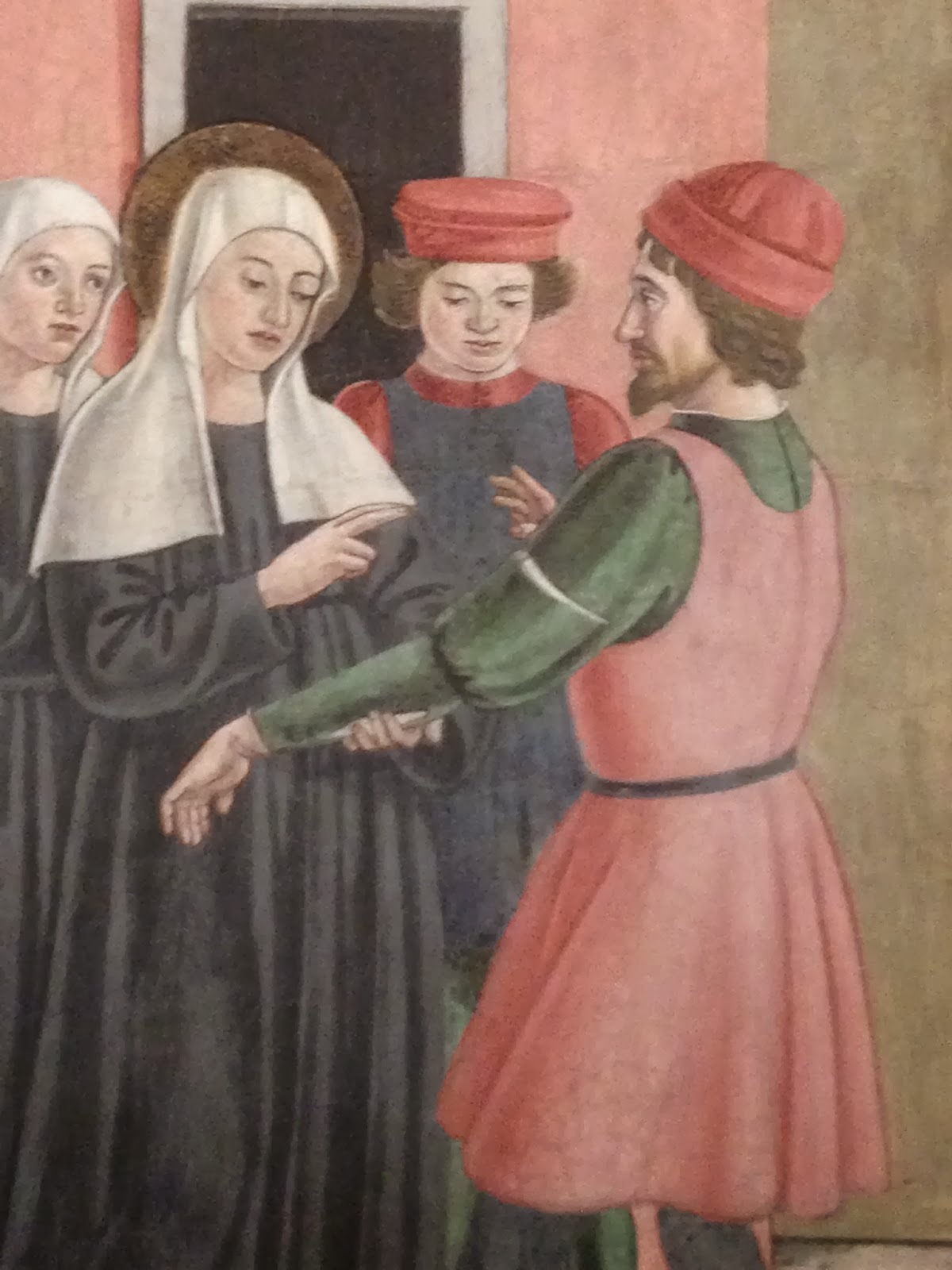
Santa Francesca Romana was a 15th-century Roman wife, mother, and noblewoman. Despite her elevated station in life, she was known for her humility, piety, and strength of faith in the face of a number of personal tragedies. She founded the religious institution the Oblate di Tor de’ Specchi, where she became the Mother Superior after her husband’s death, and was later canonized by Pope Paul V. Nearly 6 centuries later, the 9 March passing of this well-loved Roman lady is remembered every year with the one-day opening of her convent to the public.

Don’t let the line stretching down the street discourage you from visiting this extraordinary site. Unlike many medieval buildings in Rome, the remarkable convent is completely untouched by the advances of time. The interior walls were frescoed in 1468 by Antoniazzo Romano, now considered the first great Renaissance artist of the Roman school. The 25 bright and detailed panels, entirely covering the walls of the main room, depict scenes from the life of the saint and provide an important visual testimony to urban 15th-century Rome. To the further delight of historians, each panel is accompanied by a caption written in an early example of Rome’s vernacular dialect.

Don’t miss this chance to see this well-preserved example of early Renaissance art in Rome, one of the city’s truly hidden gems. But my advice is to get there early. Since 9 March falls on a Sunday this month, there are likely to be bigger crowds!

Here are a few images I snapped last year.


Santa Francesca Romana was quite the healer. These frescoes are bloody, but in a good way. And it seems that everyone who had contact with the saint had a happy ending.


 Has this guy just gotten his legs waxed? Call me silly, but that is truly what it looks like.


9 March. 8:30am­–12:30pm and 2:30–7:30pm. Via del Teatro di Marcello, 32. Tel 066797135. Free entry.

StumbleUpon Pin It

Tuesday, February 18, 2014

Michelangelo's Rome, 450 Years Later

What better way to celebrate Michelangelo's long life and immense body of work, than spending the 450th anniversary of his death taking a tour of his works. If you're lucky enough to be in his hometown of Florence today, you'll have even more opportunity to do so. But here in Rome, where Michelangelo lived and worked for much of his life, there's still a lot to see.

It is not often that one of an artist's earliest works becomes appreciated as one of his greatest masterpieces, but such is the case with the Pietà, sculpted in the last years of the 15th century, when Michelangelo was barely 25 years old.

Detail of the Pietà, Michelangelo, St. Peter's Basilica, Rome [source]

So much could be––and has been––said about this work, that I can't even scratch the surface in this little post, so I won't try. One curiosity is that it is the only work that Michelangelo ever signed, according to legend because he was frustrated that he was not receiving the proper recognition for the work, as he was new to Rome when he created it, and not yet well known there. He did this in secret, after the work had been completed and presented, and in fact, he was in such a hurry that he made a few mistakes! If you look closely you can see that he even misspelled his own name, leaving out a few letters and inserting them inside of others. I guess no one is perfect, although he came as close as anyone on Earth ever did, I'd wager.

Detail of the Pietà, signature, Michelangelo, St. Peter's Basilica [source]

After a stint in Florence, during which Michelangelo sculpted the David, he was back in Rome and working, against his will, on the ceiling of the Sistine Chapel, from 1508 to 1512. There are probably close to 7 trillion blog posts about the Sistine Chapel, so I won't bore you with another, but I will post my absolute favorite image from the ceiling. This glorious lady is the Libyan Sybil, called Phemonoe, who foretold of the "coming of the day when that which is hidden will be revealed." I have stood in the Sistine Chapel over one thousand times, and of the some three hundred figures on the ceiling, this is the one that has struck me over and over.


The Libyan Sybil, detail from the ceiling of the Sistine Chapel, Michelangelo  [source]

Sometimes looking at a great artist's plans and sketches is more revealing that looking at the finished version. Here are Michelangelo's studies for the Libyan Sybil.


Studies for the Libyan Sybil, Michelangelo [source]


The great tragedy of Michelangelo's life was that, due to forces beyond his control, he was never given the time and space to complete the tomb of Pope Julius II, the work that he believed was going to make his career and put him on the map. He of course couldn't know that he would one day be remembered as one of the greatest––if not the greatest––artists who ever lived, and he didn't need the tomb to prove that. His only completed figure of the planned tomb is the Moses, and it is only by standing in front it that you can get a true sense of its power and majesty. It is almost unbelievable that Michelangelo made drastic changes to this work, specifically changing the positioning of the left leg.

Moses, Michelangelo, San Pietro in Vincoli church, Rome [source]

I love this whimsical drawing of what it might have been like to witness Michelangelo at work on the Moses. Somehow I doubt he would have had knights and nobles loitering around his studio while he worked, and since the work was sculpted between 1513 and 1515, this image makes the artist look a little old. But it does give you the idea of the size of the great work.


[source]

It's impossible to call any work by Michelangelo "little known," but in Rome, at least this one might come close. After delighting in Gian Lorenzo Bernini's Elefantino in the piazza outside, venture inside the glorious Gothic church of Santa Maria sopra Minerva (with its starry blue ceiling that looks something like what the ceiling of the Sistine Chapel looked like before our hero got his hands on it), to find the Risen Christ, sculpted by Michelangelo between 1519 and 1521.


The Risen Christ, Michelangelo, Santa Maria sopra Minerva church, Rome [source]

From 1536 to 1541, Michelangelo found himself back in the Sistine Chapel frescoing another colossal work of art. The Last Judgement is about as different from the chapel's ceiling as one work can be from another by the same artist. Sadly, by the 1530s, the Renaissance was over, and the Counter Reformation had come to Rome. What did that mean for art? Lots of hell and damnation to scare those naughty Protestants into coming back to the Mother Church. And it also meant that shortly after Michelangelo's death, this work would be vandalized by Daniele da Volterra (but don't blame him; he was forced to do it), who added lots of scarves and other modest coverings to some of the more scandalous figures.


The Last Judgement, Michelangelo, Sistine Chapel [source]

Don't forget that Michelangelo was not only a sculptor and a frescoist; he was an architect too. Talk about a Renaissance man! From 1536 to 1546, more or less the same period he was working on The Last Judgement, Michelangelo was also redesigning the entire Capitoline Area, reversing the orientation of the square so that it turned its back on the ancient ruins of Rome's past, and looked instead toward the Vatican, and providing the Palazzo Senatorio with a new Renaissance facade. He also designed the glorious starburst pavement in the center of the square (which I love so much that I chose it as my wedding symbol), and which was not actually laid out as Michelangelo had desired until 1940.

Piazza del Campidoglio, Michelangelo, Rome [source]

In 1547, Michelangelo began designs for the dome of St. Peter's Basilica. This would be his last major work, and for the twelve years that he worked on it, he refused to receive any payment. He realized that his life was drawing to a close, and he chose to create this masterpiece for the glory of God alone, as a kind of final offering. Although the dome was not completed until after his death, his designs were adhered to with only a few exceptions.

Dome of St. Peter's Basilica, Michelangelo [source]

Michelangelo's very last project, built between 1562 and his death in 1564, is the church of Santa Maria degli Angeli e dei Martiri, an ingenious structure in which he created a Renaissance church out of a section of the ruins of the Roman bath complex, the Terme di Diocleziano. It is a stunning place to visit, however, some unfortunate "restorations" in 1749 by Luigi Vanvitelli take away significantly from the simple harmony of Michelangelo's design.

Santa Maria degli Angeli e dei Martiri, Michelangelo, Rome [source]

This list is not quite conclusive of the works by Michelangelo in Rome. To be exhaustive, I'd have to add Palazzo Farnese, a project Michelangelo took over after Antonio da Sangallo, the arch of Via Giulia, that was originally meant to be a private bridge across the Tiber, just for the Farnese family, to link their palace with their "country" home, Villa Farnesina, and of course the magnificent frescoes in the Pauline Chapel in the Vatican. The Pauline Chapel is, alas, not open to the public and its unlikely that it ever will be, as it is the pope's private chapel. But we can dream, right?


StumbleUpon Pin It

Friday, February 14, 2014

Art's Greatest Kisses

Is there anything more romantic than a kiss? In honor of the supposed most romantic day of the year, here are a few of my favorite art works featuring that most amorous of all gestures.

I've been a life-long Toulouse-Lautrec fan; he was one of my absolute favorite painters when I was a young girl. But I have never had the pleasure of seeing this work live, as it is in a private collection. I suppose I'll just have to wait and hope it comes to an exhibition near me.

The Kiss, Henri de Toulouse-Lautrec, Private Collection

I have loved this photograph since I was an adolescent. To me it was the epitome of romance, and represented all that I hoped would happen to me in my future (which I knew would undoubtedly take place in Europe). It was a great joy for me to see it at the Robert Doisneau exhibit at Palazzo delle Esposizioni in Rome two years ago.

The Kiss at Hotel de Ville, Robert Doisneau,


This sensuous work is going on exhibit along with 60 other pieces by Rodin at the National Roman Museum at the Baths of Diocletian. Rodin: The Marble, The Life opens this Tuesday, 18 February.

The Kiss, Auguste Rodin, Musée Rodin, Paris

This the only work of art that has ever literally made me cry upon seeing it live. Of course, there is another story there, which actually has to do more with Schiele than with Klimt. Perhaps I'll blog about that memorable museum visit one day.

The Kiss, Gustav Klimt, Österreichische Galerie Belvedere, Vienna

 I don't think this next one needs any commentary.

The Kiss, Francesco Hayez, Pinacoteca di Brera, Milan


And last but not least, my absolute favorite, which is, in reality, a few centimeters away from being a kiss, but perhaps that makes it all the more exquisite. You can read more about these two lovebirds, Cupid and Psyche, here and here, in two blogposts I dedicated solely to them.

Psyche Revived by the Kiss of Love, Antonio Canova, Musée du Louvre, Paris

Did I leave out any of your favorites?

All images courtesy of Wiki Commons.

StumbleUpon Pin It
Related Posts Plugin for WordPress, Blogger...