Thursday, October 10, 2013

200 Years of Giuseppe Verdi

Detail of Giuseppe Verdi portrait, Giovanni Boldini, 1886. National Gallery of Modern Art, Rome. [Source]


Today is an important day for all Italians, as opera composer Giuseppe Verdi, one of Italy’s best-loved national heroes, was born 200 years ago today, on 10 October 1813.

For Italians, Verdi is much more than just an opera composer. He is the man who wrote the soundtrack of the Risorgimento, the decades-long struggle for Italian unification and independence.

As someone who prefers the music of Puccini to Verdi hands down (I’ve received a lot of flack for this from Italians over the years), I didn’t always get the connection between Verdi and Italy. When I first arrived in Rome, still plenty wet behind the ears, someone explained to me that every true Italian prefers Verdi’s operas to Puccini’s. While I adore Verdi as well, Puccini, with his passionate, flowering, uber-Romantic melodies, was to my mind much more the embodiment of the Italian soul. Verdi was Grand Opera with a capital G. His operas tell the stories of kings and queens, grand passions and grand ideals, with massive choruses and formidable heroines. It’s all a trifle distant from the real world of Italian experience. Clearly, I didn’t get it.

Portrait of Giuseppe Verdi. [Source]

As heavenly as Verdi’s music is (La Traviata’s “Addio al Passato” is, in my opinion, his most beautiful and heart-wrenching piece), Italians’ love for Verdi isn’t really about his music at all. It’s about his role as a patriot, someone who, through his music and through his political actions, fought to bring Italy together. Even the letters of his name became an acronym for the dream of the unification of Italy, as revolutionaries scrawled “Viva VERDI!” on walls, secretly expressing their support for the man who would go on to become united Italy’s first king, Victor Emanuel Re D’Italia (V-E-R-D-I)

Verdi’s slave chorus “Va’Pensiero” from Nabucco is the unofficial Italian national anthem, a hymn almost any Italian alive could sing on the drop of a hat if asked, a song that represented to Italians in the mid-1800s their own loss of freedom to the Austrians who ruled northern Italy at that time. I'll never forget the night, back in March of 2011, when I attended Nabucco in Rome on the 150th anniversary of the Unification of Italy, when Maestro Muti asked the audience to sing along with "Va' Pensiero." I wrote about it here.


Earlier this year, I had the honor of interviewing the greatest Verdi conductor alive today, Maestro Riccardo Muti. For those of you who know my operatic past, this was a very, very big deal for me. I chatted with the Maestro about the importance of Verdi to Italians, the future of opera in Italy, a country that has been de-funding its cultural institutions, and the Maestro’s plans for the Rome Opera, of which he has recently become the Honorary Conductor for Life.


The interview appeared in the March 2013 issue of WHERE Rome magazine, but I’ve posted an excerpt of it here in honor of Verdi’s 200th birthday. (You can see the PDF version of the full interview here.)

T.P.: Who is Verdi to you? Do you consider him a musician or a national hero?

R.M.: Verdi is one of the greatest pillars of operatic music. He represents the soul, not just of Italy, but of all humanity. People in every corner of the world, from Australia to America, Canada, or Africa, can find elements in Verdi’s music that speak to their very heart and soul. In this sense, he is one of the most universal composers in the history of music. As a national hero, Verdi was a man who, through his music and his ideals of democracy, freedom, and equality, helped to ignite the hearts of Italian revolutionaries during the Risorgimento, undoubtedly contributing to the unification of Italy.

T.P.: Historically, opera in Rome has developed less rapidly than in other Italian cites, such as Milan and Venice. Since you have come to the helm of the Rome Opera, however, it has begun receiving wider acclaim, for example, the extraordinary triumph of this season’s opener, Simon Boccanegra. What is your plan for bringing Rome to the highest possible level of operatic greatness?

R.M.: It’s important to note that Rome has had great opera houses, such as the Apollo, the Valle and the existing Teatro Argentina, which predate the current Teatro Costanzi, and also that Verdi had a strong and active relationship with Rome. Rome’s present opera house may have a shorter history than Italy’s historic theaters, like La Fenice or La Scala, but the Teatro Costanzi has a history of many important conductors as well as premieres, including Tosca and Cavalleria Rusticana. Then followed a period of decline, during which it attracted less public attention. It is now experiencing a strong revival because the orchestra, chorus, and technicians have enthusiastically reattained past levels of brilliance, although it has been an uphill battle. Of course, the credit does not go to only one person; it is all about teamwork. Everyone is contributing; for example the orchestra has been performing symphonic concerts with major conductors, doing some excellent work. All this raises the level of the company and gives the public new faith in the quality of the opera house, and the most important thing is that the public see the theatre as a house of culture, art, and music. Once that happens, progress becomes easier.

T.P.: No tourist would come to Rome without visiting the Sistine Chapel or the Colosseum. Would you suggest a tourist also attend an Italian opera, perhaps by Verdi, to get a complete picture of Italian culture and history?

R.M.: In recent years, opera has enjoyed an increasingly positive reputation at the international level. When tourists come to Rome, a city thousands of years old, it’s natural that the ancient sites and museums will immediately grasp their attention, but if people come to learn of the history of Rome’s opera house––for example, that it hosted the premiere of Puccini’s Tosca, one of the most performed operas of all time and known to all music lovers around the world––more tourists will visit our theater. However, I am confident that, little by little, this will occur.

T.P.: In light of heavy cuts to cultural funding in Italy, as well as the economic crisis in general, is there a risk that opera––an integral part of Italian culture––is increasingly becoming a privilege reserved for the elite?

R.M.: People were asking that even when I was a child. Of course, the arts have always been of greater interest to those who have the financial resources to attend universities or academies, and so in that sense there is a cultural elite. The solution then would be a cultural education that begins in primary school, in which all children, regardless of their financial situation, would have the privilege to learn about one of the most important and foundational pillars of our history and our country, namely, music. Italy's contribution to music is centuries old, and an understanding of it is essential to create a society in which classical music is available to everyone. Otherwise, it’s inevitable that this privilege will become reserved for a few devoted fans and those who have the financial means to attend the opera. It’s a matter of education, which is the duty of the state.

T.P.: What kind of non-classical music does Maestro Muti listen to?

R.M.: I have three children, so when they were young I listened to many different genres of music at home, although I didn’t have the time to really study them. Of course, when I was a kid I remember adoring the Platters, and now, when my five-year-old grandson is in the car, he always asks to hear their hit Only You. They were amazing. Over the years, I've been struck by other singers, for example the Beatles were a brilliant group. I've always been fascinated by a voices like Céline Dion and the late Whitney Houston, although less for the content of their music than for the beauty of their voices.

With Maestro Riccardo Muti after a performance of Verdi's I Due Foscari at the Teatro dell'Opera di Roma


**This interview has been translated from Italian.**
StumbleUpon Pin It

Friday, October 4, 2013

Five Ways to Celebrate St. Francis’s Feast Day in Italy


The Day after Pope Francis's election, Piazza San Francesco a Ripa. ©Tiffany Parks

Since I live on a street dedicated to St. Francis of Assisi, and since I can see a church dedicated to St. Francis of Assisi right out my bedroom window, and since my darling Maritino and I were married by a Franciscan priest, and since our current ever more lovable Pope chose his papal name (many believe) to honor St. Francis of Assisi, I figured it would be a good idea to write a little post today on 4 October, on occasion of the feast day of one of Italy’s all-time best-loved saints.

Instead going into St. Francis’s life andworks, which I’m guessing most people are already familiar with, I thought I’d suggest five ways to celebrate his feast day, and five different Italian cities in which to do it.

Assisi

Basilica of San Francesco d'Assisi, Assisi. [source]

As the saint’s hometown, this is the obvious choice. In fact, this is where Pope Francis himself decided to celebrate St. Francis’s Day, so expect a lot of crowds if you choose this option. Besides the sheer majesty of the 13th-century basilica, one of the most important fresco cycles of the great Giotto di Bondone, and in fact one of the most celebrated works of art of that magical period when the buds of medieval art began to blossom into the Renaissance. 

The Woman's Confession, Giotto. Basilica of San Francesco d'Assisi, Assisi. [source]

The Dream of the Palace, Giotto. Basilica of San Francesco d'Assisi, Assisi. [source]


San Francis receives the Stigmata, Giotto. Basilica of San Francesco d'Assisi, Assisi. [source]

The 28 frescoes that line the lower section of the nave of the Basilica of San Francesco d’Assisi tell the story of the saint’s life and are believed to have been painted between 1296 and 1304. Bonus: an even earlier portrait of St. Francis, by late-medieval master Cimabue, can be seen on the transept wall. The fresco, Our Lady Enthroned with St. Francis, dates to 1280 and features one of the most well known depictions of the saint.


Our Lady Enthroned with St. Francis, Cimabue. Basilica of San Francesco d'Assisi, Assisi. [source]

The basilica also contains the saint’s tomb.

Tomb of St. Francis of Assisi. Basilica of San Francesco d'Assisi, Assisi. [source]


Florence

Basilica of Santa Trinità, Florence. [source]

If you prefer high Renaissance art to late medieval/early Renaissance crossover art, and you happen to be in Florence today, you’re in luck! Head to Santa Trinità church where you can visit the Sassetti Chapel, containing an exquisite fresco cycle by Domenico Ghirlandaio (who just happened to be Michelangelo’s first master, and one of the painters of the walls of the Sistine Chapel). The fresco, dating from 1482-1485, depict several scenes of St. Francis’s life, including the receiving of the stigmata, the confirmation of Franciscan rule, and the resurrection of a boy.

Confirmation of Franciscan Rule, Ghirlandaio. Church of Santa Trinità, Florence. [source]

St. Francis's Trial by Fire, Ghirlandaio. Church of Santa Trinità, Florence. [source]


Death of St. Francis of Assisi, Ghirlandaio. Church of Santa Trinità, Florence. [source]

Chiusi della Verna

Santuario della Verna, Chiusi della Verna. [source]

Not many tourists make it to this tiny little town in the province of Arezzo, but if you’re in the general area today, consider a visit to the Santuario della Verna, just a few miles outside of town. In addition to its evocative setting, perched on an outcropping of Mount Penna, the sanctuary is also renowned for being the site at which St. Francis received the stigmata, on 14 September 1224. You can also visit a small museum attached to the sanctuary where you can see St. Francis’ rough habit, slightly moth-eaten, but still intact.

Habit of St. Francis of Assisi, Santuario della Verna, Chiusi della Verna. [source]


Subiaco

St. Benedict's Monastery, Subiaco. [source]

This gorgeous hilltop town, famous for its medieval Benedictine monasteries, is not generally associated with St. Francis of Assisi, but there is one notable curiosity for those seeking to pay homage to the saint today. In St. Gregory’s Chapel in the Monastery of St. Benedict is only known portrait of St. Francis painted during his lifetime. The portrait shows neither halo nor stigmata, showing it was indeed painted before the saint’s death in 1226. If you want an idea of what he actually looked like, this is probably as close as you’ll come.

Portrait of St. Francis of Assisi, St. Gregory's Chapel, St. Benedict's Monastery, Subiaco. [source]


Rome


Church of San Francesco a Ripa, Rome. ©Tiffany Parks
 
If you’re in the Eternal City today, never fear! You don’t have to travel anywhere if you want to make a St. Francis pilgrimage of your own. The church of San Francesco a Ripa in Trastevere is attached to a convent that housed St. Francis when he was in Rome in 1209 seeking recognition of his order by Pope Innocent III. If you ask the custodian nicely (and if your shoulders and knees are modestly covered!) he’ll happily take you up to the very cell St. Francis slept in, complete with the very stone he used for a pillow, which visitors are allowed to touch.

The rock St. Francis used as a pillow, Cell of St. Francis of Assisi, Church of San Francesco a Ripa, Rome. [source]


While you visit the church (which by the way also contains Bernini’s late masterpiece The Ecstasy of the Beata Ludovica Albertoni), take a moment to wallow bitterly in the knowledge that this unassuming little trasteverina church once contained, along the walls of the nave, the prototype of the legendary Giotto cycle in Assisi. The frescoes depicting scenes from the life of St. Francis, attributed to Pietro Cavallini, are sadly now lost. “Now lost”: two words that inspire the wrenching of hearts and gnashing of teeth of many an art lover.
StumbleUpon Pin It

Wednesday, July 24, 2013

La Festa de' Noantri, the festival of the Trasteverini


Festa de' Noantri procession, 1950s [source] 


I remember that morning like it was yesterday: a bright mid-summer dawn, just weeks after moving into my dream Trastevere apartment. In a haze of grogginess and not enough sleep, I hear a booming, nasal voice. It's Sunday and seems impossibly early for whatever is happening, especially as it's happening right outside my bedroom window. 


I bury my head in my pillow as I hear a monotone voice bleating out of a loudspeaker. Yes, a loudspeaker. A half-blind glance at my phone shows it’s not even 7am. "...Madre di Dio, prega per noi peccatori..."

Madre di Dio, what the...?

This I had to see. I flop out of bed and stumble over to the window. "Ave Maria, piena di grazia..." the voice drones on. Opening the shutters, I peer below.


Festa de' Noantri, Via Garibaldi, 2010, Crazy o'clock AM

Festa de' Noantri, Via Garibaldi, 2010

Festa de' Noantri, Via Garibaldi, 2010

A procession, a full-on religious procession, was trundling past my window. There were priests, altar boys, a smattering of older ladies in somber dress. They were all doing a call-and-repeat version of the Ave Maria that I have since become much more familiar with. Oh, and they were carrying a gigantic statue of the Virgin Mary on their shoulders. One thing I have learned living in Italy is that Italians love the Virgin Mary. I mean, they love her more than Jesus. Or so it seemed to my then-non-Catholic self. I had almost literally stumbled upon the Festa de’ Noantri.

The pictures I've included here were not, of course, taken that morning, but four years later, when I was sadly packing up to leave that very same apartment and knew I was going to miss everything about it (besides the landlord).  Little did I know then that my new apartment would be on the self-same procession route. It’s actually not so improbable; the Festa de’ Noantri procession goes down practically every street in Trastevere.

For a little bit of historical background (and a break from my nonsensical reminiscing), the festival dates back to 1535 when, after a storm, a cedar statue of the Madonna was fished out of the Tiber (on the Trastevere side, let it be noted!). Exactly where the statue came from is still a mystery, but where it ended up is not. It was donated to the order of the Carmelites, and hence it became known as the Madonna del Carmine (although many still refer to it as the Madonna della Fiumarola, since it was found in the river). The statue was kept in San Crisogono, an ancient church in Piazza Sonnino, and was immediately considered the protectress of the trasteverini. The statue was eventually transferred to the unassuming church of Sant’Agata, right across the square.

Every July, the first Saturday after the 16th to be precise, a major 8-day festival takes place in my beloved neighborhood to celebrate this “miraculous” statue (if you can consider a statue be fished out of a river a miracle). The original statue stays put in Sant’Agata (these days she’s too precious to move about), but a 19th-century polychrome wooden copy is carried about to much fanfare and jubilation (and yes, they change her outfit every year). 

Festa de' Noantri, Pza San Francesco d'Assisi, 2012

Festa de' Noantri, Pza San Francesco d'Assisi, 2012

Festa de' Noantri, Via San Francesco a Ripa, 2012

After a goodly number of masses and benediction ceremonies, she is carried in solemn procession from Sant’Agata to the original statue’s first home, San Crisogono. But don’t think they just walk her across the square. That would be too easy. No, she is carried down Via della Lungaretta, Via della Luce and into Piazza San Francesco d’Assisi (where another celebration takes place), down Via San Francesco a Ripa, Via Natale del Grande, Via Roma Libera, and many more streets in Trastevere, until she is finally deposited at San Crisogono, where she stays for the duration of the festival.

Festa de' Noantri, Via San Francesco a Ripa, 2013

Festa de' Noantri, Via San Francesco a Ripa, 2013

Festa de' Noantri, Via San Francesco a Ripa, 2013

My friend Jill watching the procession from across the street

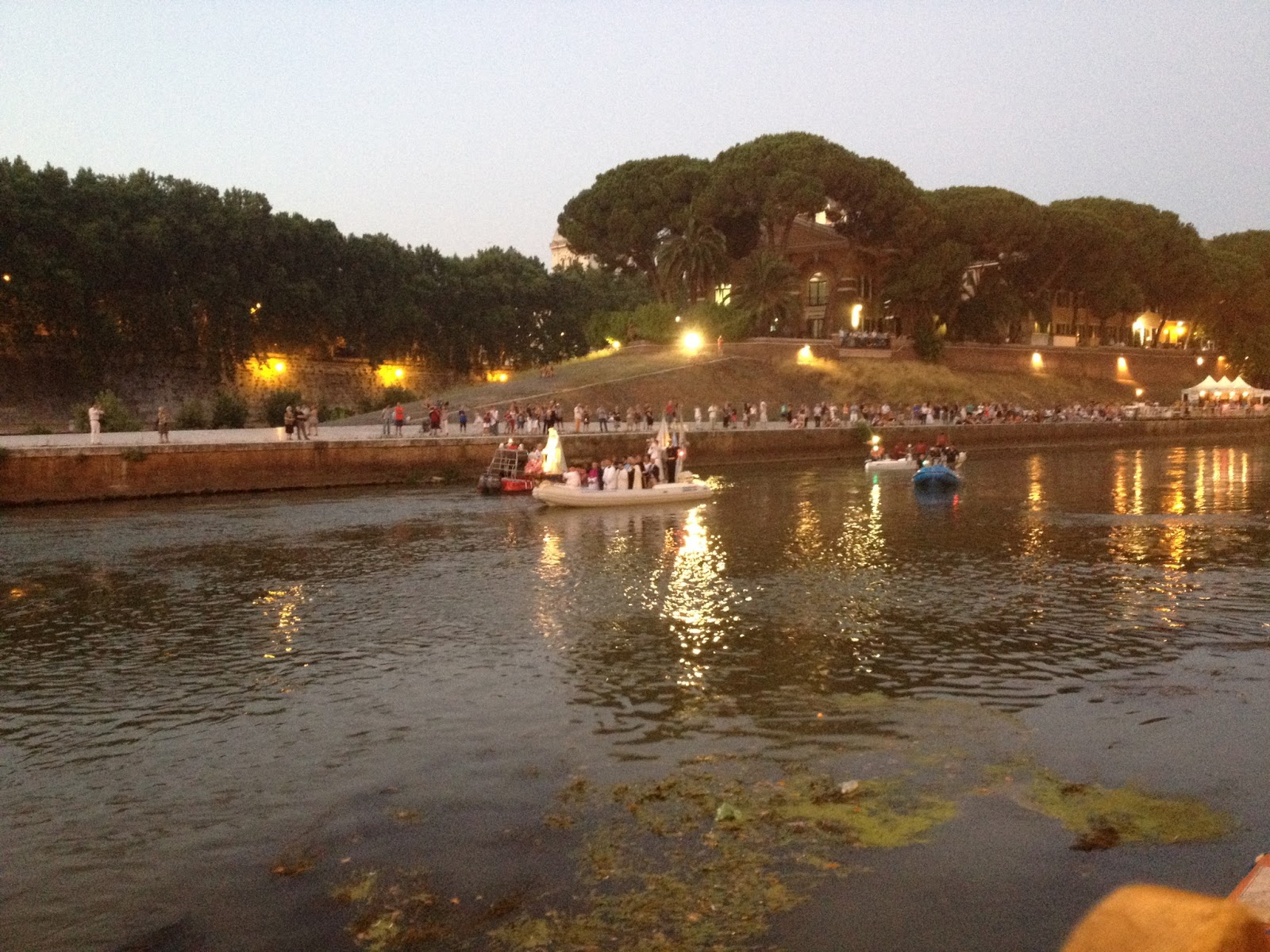
Then the partying begins: street concerts of traditional music (cue: Roma,nun fa’ la stupida sta sera), old folks literally dancing in the streets, stall selling porchetta in Piazza Sonnino, bersaglieri playing their trumpets while they run (seriously impressive), and endless shouts of “Evviva Maria!” to be heard at any time of day or night. At the end of the festival, the pièce de resistance is when hundreds of people line the river or stand on the bridges to watch the Madonna float down the Tiber on a boat at sunset, from Ponte Sant’Angelo to Ponte Garibaldi.

Madonna della Fiumarola, Ponte Garibaldi, 2012

Madonna della Fiumarola, Isola Tiberina, 2012

So why is it called the Festa “de’ Noantri”? The word Noantri is a dialectical version of “noi altri” (us others). This was a way the residents of Trastevere voiced their indignation at the phrase, “voi altri che abitate in altri quartieri” (you others who live in other neighborhoods), with which they were referenced by the Roman populace. They were considered 2nd-class citizens because they lived on the wrong side of the tracks Tiber. 

I feel very differently about the Festa de' Noantri these days, and that has less to do with the fact that I'm a Catholic convert (that's a story for another post), and more to do with the fact that the procession no longer wakes me up on Sunday mornings. It still passes under my bedroom window (although I now live in a different apartment on a different street), but it does so around 7 o’clock on Saturday night instead of 7 o’clock on Sunday morning, and that makes all the difference. In fact, I’ve come to love this festival. I’m now in my 8th year of witnessing it on my very street and it literally never gets old.

Festa de' Noantri, Piazza San Francesco d'Assini, 2012

If you happen to be in Trastevere tonight (Wed, 24 July 2013), get over to Piazza San Francesco d'Assini, stat! A brass band is playing as I write this, and who knows? Maybe the bersaglieri will show up with their fantastic feathered hats? I know I’ll be watching from my window.


Visit the festival's official site for a program of processions and events. 

All photos (except first) by author.

StumbleUpon Pin It
Related Posts Plugin for WordPress, Blogger...